Key takeaways
- The 0.1% limit applies to each homogeneous material, so a 0.3 µm passivate film is judged on its own mass and dilution by the steel beneath it is not a defence.
- Cadmium is the tightest limit in the directive at 0.01%, ten times stricter than the other nine substances.
- Ask for the directive reference and the exemption number, not the phrase lead-free: Annex III exemption 6(a) permits up to 0.35% lead in steel by weight.
- Total chromium read by XRF cannot separate Cr(VI) from Cr(III) in a passivate film, so a plating declaration or a speciation test is the only usable evidence.
A zinc-plated bracket passes dimensional inspection, ships inside a controller cabinet, and eight months later stops a compliance audit. The plating is sound and the dimensions are in tolerance. The clear passivate on the zinc contains hexavalent chromium, and the 0.1% limit applies to that film, not to the 400 g of steel underneath it.
RoHS restricted substances are controlled by Directive 2011/65/EU, amended by Delegated Directive (EU) 2015/863, and the ten substances it lists are limited by weight in each homogeneous material of the finished electrical and electronic equipment. A fabricated part inherits the requirement from the product it enters, which changes the question a buyer should ask. Not "is this part compliant", but "which material in this part carries the risk, and which document proves the answer".
The standards and compliance hub holds the rest of this cluster, including the REACH obligations that sit alongside RoHS and the material certificates that support both.
Does RoHS apply to a sheet metal part, or to the equipment it enters?
It applies to the equipment. Directive 2011/65/EU covers electrical and electronic equipment placed on the EU market in the eleven categories of Annex I: household appliances, IT and telecommunications equipment, consumer equipment, lighting, tools, toys and leisure equipment, medical devices, monitoring and control instruments, automatic dispensers and the catch-all eleventh category. A bare steel bracket is not equipment, so the directive places no duty on the bracket as an object.
The duty lands on the producer who puts the finished product on the market, and that producer pushes a requirement down the bill of materials. That is why three parts leaving the same press shop get three different answers.
A data-centre rack frame, a controller enclosure and a genset canopy all come out of the same 12 kW laser, but only the first two are part of electrical equipment in the ordinary sense. A canopy around a diesel generator is a machine guard, and a railway coach panel is part of a means of transport, which Article 2(4) excludes along with military and space equipment, large-scale fixed installations and large-scale stationary industrial tools. The exclusion is about the product category, not about the material, so a buyer's own specification can still impose the limits on an excluded product.
Practical consequence: read the customer's requirement before the drawing. If the part goes into equipment sold in the EU, assume RoHS applies and treat the exemption list as part of the specification. If the part goes into a fixed installation or a generator set, RoHS may not apply, but the coating still has to satisfy REACH and the customer's own restricted substance list, which is usually stricter.
The ten RoHS restricted substances and where they hide in fabricated parts
The limits below are the ones in the directive, expressed as a percentage by weight of each homogeneous material. The third column is what matters on a shop floor: the process or bought-in item where each substance actually turns up.
| Substance | Limit (% w/w, homogeneous material) | Where it appears in fabricated parts | Ganesh limit or note |
|---|---|---|---|
| Lead (Pb) | 0.1 | Free-machining brass, solder, some pigments, residual in recycled steel | Declare Annex III 6(a) for steel, 6(c) for copper alloy; mill certificate held per heat |
| Mercury (Hg) | 0.1 | Relays, switches, some legacy sensors | Not used in our forming or finishing route; bought-in components only |
| Cadmium (Cd) | 0.01 | Silver brazing filler, contact materials, some plating | Ten times stricter than the rest; no cadmium in our zinc or powder inputs |
| Hexavalent chromium, Cr(VI) | 0.1 | Chromate conversion coatings on zinc, some wash primers | The most common failure on fabricated parts; passivation chemistry is specified per drawing |
| Polybrominated biphenyls (PBB) | 0.1 | Legacy flame retardants in plastics | Metal parts unaffected; check gaskets, cable and labels |
| Polybrominated diphenyl ethers (PBDE) | 0.1 | Legacy flame retardants in plastics | As above, bought-in items only |
| DEHP | 0.1 | PVC gaskets, cable, plasticised seals | Bought-in items; a gasket is a separate homogeneous material |
| BBP | 0.1 | Plasticisers in seals and cable | Bought-in items |
| DBP | 0.1 | Plasticisers and some inks | Bought-in items, including printed labels |
| DIBP | 0.1 | Plasticisers, added by the 2015 amendment | Bought-in items; applies to categories 1–7 and 10 from 22 July 2019 |
Nine of the ten sit at 0.1%. Cadmium sits at 0.01%, and that single zero is why a "trace" cadmium reading in a zinc alloy or a brazing filler is treated as a failure rather than a rounding error.
Where the 0.1% is measured: the homogeneous material rule
The threshold applies to a homogeneous material, defined in the directive as a material of uniform composition throughout, or a combination of materials that cannot be mechanically disjointed into different materials. "Mechanically disjointed" means separable by unscrewing, cutting, crushing, grinding or an abrasive process.
A plated and powder-coated panel is therefore not one material. It is steel, plus a zinc layer, plus a passivate film, plus a cured powder film, and each is assessed on its own mass.
The arithmetic is unforgiving. Take a 2 mm CRCA panel at 1,000 mm × 500 mm. At 7,850 kg/m³ the steel alone is 7.85 kg. A conversion coating 0.3 µm thick at a density near 2,500 kg/m³ weighs about 0.75 g/m², so the two faces carry roughly 0.75 g of film in total. If that film is 1% hexavalent chromium by mass, it holds 7.5 mg of Cr(VI). Against the film's own 0.75 g the concentration is 1%, which is ten times the limit.
Against the panel's 7.85 kg, the same 7.5 mg is 0.0001%. The tempting defence — "it is a trace in a large part" — is exactly the argument the homogeneous material rule exists to defeat. Thicker steel makes the number smaller and changes nothing about the result.
Two rules follow. First, the risk always sits in the thin layer, because thin layers are almost entirely surface chemistry: passivates, sealers, adhesives, paint films and printed labels. Second, a plated fastener cannot borrow compliance from the assembly it is screwed into. The bolt is its own article with its own coating, assessed on the same percentage.
A zinc layer on its own is rarely the problem. Zinc plating is better than 99.9% zinc, and the alloying additions in a zinc-nickel or zinc-iron layer sit in the percent range but not in the restricted list. The passivate over it is the layer to interrogate, and so is any sealer applied on top.
Exemptions that keep lead in the part, and why they have an expiry
Annex III of the directive carries time-limited exemptions, and three of them matter to fabricated metal:
- 6(a) — lead as an alloying element in steel, up to 0.35% by weight.
- 6(b) — lead as an alloying element in aluminium, up to 0.4% by weight.
- 6(c) — lead in copper alloy, up to 4% by weight.
A free-machining brass terminal with 2–3% lead is compliant only because of 6(c). Remove the exemption and the same part fails by a factor of twenty. Steel is subtler: most CRCA and structural steel meets 0.1% lead without relying on 6(a), because lead is a residual from scrap rather than an intentional addition, but a resulphurised or leaded free-machining grade will not.
Exemptions are renewed on a cycle, and each renewal is a decision point. A part approved under 6(c) should carry the exemption number and a review date in its compliance file, so that the file is re-opened when the entry is revised rather than when the customer's auditor arrives. Writing "RoHS compliant" without the exemption reference shortens the document and lengthens the argument.
Designing the exemption out is often cheaper than managing it. A copper alloy at 0.05% lead costs more than a free-machining grade at 3%, but it removes a renewal date from the part's life. Where the part is a busbar, an earth strap or a terminal block and the machinability gain is small, the substitution is worth pricing before the drawing is released.
What evidence to ask for, and what each document proves
Four documents circulate under the heading of RoHS compliance, and they are not interchangeable.
A declaration of conformity is the supplier's statement that the part meets 2011/65/EU, listing the homogeneous materials covered and any exemption used. It is only as good as the supplier's records, and it should be signed at part level, not at company level.
Technical documentation to EN IEC 63000:2018 is the structure a manufacturer keeps to demonstrate assessment of equipment against the restricted substance limits. The standard defines what the file contains and how long it is retained; it does not define a test and it does not certify a part. A supplier letter citing EN IEC 63000 is telling you the paperwork exists, not that the coating was measured.
A test report is measurement evidence. The IEC 62321 series sets the methods for determining restricted substances in electrotechnical products, and a usable report names the homogeneous material, the sample preparation, the instrument and the laboratory's accreditation to ISO/IEC 17025.
An XRF screening sheet is the weakest of the four, and the one most often emailed. Handheld X-ray fluorescence reads total elemental content in seconds, which is useful for screening lead, cadmium and mercury. It cannot separate chromium oxidation states. A trivalent passivate and a hexavalent chromate both read as chromium, often in the same low-thousands ppm range, so a total chromium reading above 1,000 ppm on a plated part proves nothing either way.
That leaves two usable routes for a zinc-plated part: the plating supplier's declaration naming the passivate chemistry, or a speciation test on a coupon, using a method written for conversion coatings such as ISO 3613, which covers the determination of hexavalent chromium on zinc and cadmium coatings. Ask which one the supplier holds before accepting the part.
The same logic applies to bought-in items. Gaskets, cable glands, labels, rivets and earth studs are separate homogeneous materials that arrive with the supplier's paperwork, and they are the items most often missed when a bill of materials is assembled late.
What Ganesh runs, and where our part of the answer stops
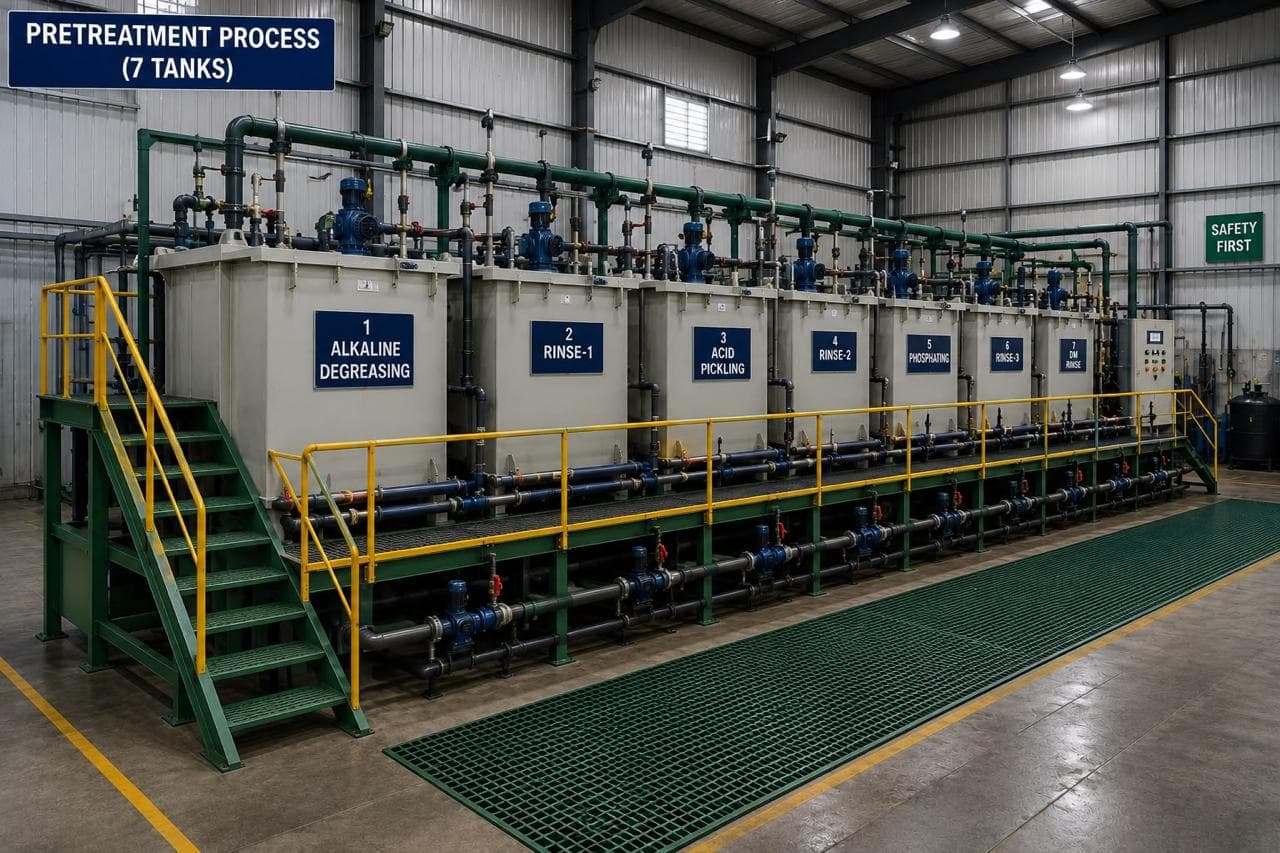
Ganesh forms and finishes parts from 0.8 mm to 40 mm in mild steel, CRCA, stainless steel, aluminium, brass and copper. Finishing runs through a seven-tank pretreatment line, a 16 ft × 16 ft shot blast chamber, an 18 ft × 14 ft electrostatic powder booth, a wet paint booth and a curing oven, with dry film thickness measured and cross-hatch adhesion testing on coated lots. The works operate under ISO 9001:2015 and ISO 14001:2015, and the paint shop capability describes the finishing route in full.
For compliance work, the useful output from a fabricator is the record set: the mill certificate for the coil and its heat number, the finish specification actually applied, the coating batch, and the thickness and adhesion results for that lot. First article inspection and PPAP are available where the customer's programme calls for them, and both are places to attach a compliance file to a physical part.
Where the answer stops is at the equipment. Ganesh is not the producer of the electrical equipment and does not issue the CE marking or the EU declaration of conformity that goes with it. Restricted substance testing is a third-party laboratory activity; we supply the material and finish records that make the test meaningful, and the part-level declaration is built from those records plus the bought-in component paperwork. A buyer who wants the test itself should budget for the laboratory, and for the two weeks a speciation test usually takes.
What to put on the drawing and in the RFQ
- The market and the product category, so the supplier knows which regime applies.
- The finish specification by chemistry, not by colour: trivalent passivate on zinc, powder type and film thickness.
- The material grade with its standard, so the alloy exemptions can be checked rather than assumed.
- The exemption numbers the design relies on, if any.
- The documents required at first article: declaration, test reports, mill certificates, coating batch record.
- The retention period for the compliance file, which is usually the life of the part plus one year.
- Any customer restricted substance list that goes beyond RoHS, which is common in automotive and appliance programmes.
The drawing package that supports a quotation covers the rest of the fields; finish chemistry is the one most often left as a colour name. The RFQ checklist is the shorter version for a laser-cut or formed part, and a quote request is the place to state which market the equipment ships to.
When RoHS is the wrong frame
For a genset canopy, a fixed industrial installation or a railway coach panel, the directive does not apply, and a supplier asked to certify it will either invent an answer or price the uncertainty into the quote. What applies instead is REACH, the customer's own restricted substance list, and for rolling stock the railway specification.
For equipment sold outside the EU, RoHS is not the governing text. The limits are similar in several jurisdictions, and the documentation route is not, so a declaration written for the EU will not satisfy a customer who needs a different regime. Ask which one before the first lot.
Where the part is a coating-only item, such as a powder-coated panel supplied to a customer who does the assembly, the honest position is that we can declare the substrate and the coating system, and the customer owns the finished equipment declaration.
Send the drawing with the finish chemistry and the market, and the engineering team will return the route, the record set and the points where a third-party test is the only defensible evidence.
Frequently asked questions
Does a bare sheet metal bracket have to be RoHS compliant?
Only through the product it goes into. Directive 2011/65/EU applies to electrical and electronic equipment in the eleven Annex I categories, so a bracket inside a data-centre rack or a controller cabinet is in scope and a bracket inside a genset canopy is not. The obligation sits with whoever places the finished equipment on the EU market, and it travels down the bill of materials as a requirement on us.
Is a plating thickness of 8 µm enough to make the chromium problem go away?
No. The passivate is a separate homogeneous material from the zinc and from the steel, so the threshold is calculated on the film. A 0.3 µm chromate film containing 1% Cr(VI) is roughly 7.5 mg/m² of hexavalent chromium, which fails even though it is about 0.00005% of a 2 mm panel's mass.
What is the difference between an RoHS declaration and a test report?
A declaration is the supplier's statement of conformity to 2011/65/EU, listing any exemption relied on. A test report is measurement evidence for a named homogeneous material, usually to the IEC 62321 methods. Buyers normally need both: the declaration covers the part, the report covers the material that carries the risk.
Can a supplier use the lead exemption for steel on any part?
Only where the lead is present as an alloying element and stays at or below 0.35% by weight in the steel. Exemption 6(a) is time-limited and has to be renewed, so a part that depends on it carries a review date. Copper alloys have their own entry, 6(c), which allows up to 4% lead.
Does RoHS cover the powder coating on a panel?
The coating is assessed as a homogeneous material of the equipment, so yes. In practice cured powder is a cross-linked film with pigments and fillers, and the substances that trip the directive are pigments, stabilisers and plasticisers. Ask the coating supplier for a declaration per batch rather than a generic brochure statement.
Sources and further reading
- Directive 2011/65/EU on the restriction of the use of certain hazardous substances in electrical and electronic equipment (RoHS 2) · reviewed 3 Nov 2026
- Delegated Directive (EU) 2015/863 adding the four phthalates to Annex II of Directive 2011/65/EU · reviewed 3 Nov 2026
- European Commission — RoHS Directive: scope, exemptions and guidance · reviewed 3 Nov 2026
Have a drawing that carries a compliance requirement?
Send the drawing with the finish specification, the material and the market the equipment ships to. We review the route and list the records that will travel with the lot before quoting.
Request a quote