Key takeaways
- The REACH threshold is 0.1% by weight of the article, calculated on the whole part, so a 120 g powder film on an 11.8 kg panel only trips it at roughly 9.8% of the coating.
- A safety data sheet covers a substance or mixture and never satisfies Article 33, which asks for the substance name, its location in the article and safe use information.
- A declaration must name the candidate list version it was assessed against, because the list is revised about twice a year.
- Nickel release under Annex XVII entry 27 is the restriction that catches handrails and grab rails: 0.5 µg/cm²/week on items held in prolonged skin contact.
A lift car handrail ships to a European assembler, the powder supplier reformulates a primer, and the customer's quality team asks for an updated Article 33 statement within the month. The certificate on file says "REACH compliant" and names no substance, no date and no article. It answers nothing, and the lot waits in a warehouse while three companies work out who holds the data.
REACH chemical compliance for a fabricated part comes down to four obligations: telling the recipient what is in the article, feeding the SCIP database, respecting the restrictions in Annex XVII, and knowing when an authorisation is needed. None of them require the fabricator to register a chemical. All of them require numbers about the part.
The standards and compliance hub collects the related articles on RoHS and on material certification, which sit on either side of this one.
What does REACH chemical compliance ask of a part rather than a chemical?
REACH, Regulation (EC) No 1907/2006, runs four processes: registration, evaluation, authorisation and restriction. Registration is the obligation of whoever manufactures or imports a substance in the EU above one tonne a year. A press shop that buys steel, powder and pretreatment chemicals does not register anything.
What a fabricator does hold is the role of producer of an article. An article is an object that takes a shape, surface or design that determines its function more than its chemical composition does. A bracket is an article. A coil of steel is an article. A drum of powder is not; it is a mixture, and it is supplied with a safety data sheet.
Four duties attach to the article, and a fifth is often confused with them:
- Article 33 communication. Any candidate list substance present above 0.1% by weight of the article must be disclosed to the recipient, with enough information for safe use.
- SCIP notification. Articles placed on the EU market containing a candidate list substance above 0.1% must be notified to the ECHA database, an obligation that arrived through the Waste Framework Directive on 5 January 2021.
- Annex XVII restrictions. These apply to articles as placed on the market, regardless of tonnage, and they include limits that hit metal parts directly.
- Authorisation. A substance on Annex XIV cannot be used unless an authorisation is granted, and a producer of an article that contains one has to notify ECHA where the substance is present above 0.1% and totals more than one tonne a year.
- Safety data sheets. Annex II sets what a data sheet contains. It applies to substances and mixtures, and it is not an article declaration, however often it is sent as one.
The obligations, the trigger and who actually holds the file
The table maps each duty to the number that triggers it and to the party who can answer. The last column is where a sheet metal supplier can and cannot help.
| Obligation | Trigger | Party that holds the record | Ganesh limit or note |
|---|---|---|---|
| Article 33 information to a recipient | Candidate list substance > 0.1% w/w of the article | Producer of the article, at the point of supply | We can declare the substrate and coating; bought-in seals and labels need their own statements |
| Article 33 answer to a consumer | Same 0.1% threshold, answered free of charge | Producer of the article, within 45 days | Not our role unless we place the article on the market |
| SCIP notification | Candidate list substance > 0.1% w/w, article on the EU market | Whoever places the article on the market | We supply substance, concentration range and location data to support the filing |
| Annex XVII restriction | Any article placed on the market, no tonnage threshold | Producer and importer, checked by market surveillance | Nickel release on handrails is the entry that most often affects our parts |
| Annex XIV authorisation | Substance on the authorisation list, > 0.1% w/w and > 1 t/a | Producer of the article, notifying ECHA | Requires a data route through the coating or alloy supplier |
| Safety data sheet (Annex II) | Substance or mixture supplied | Supplier of the chemical | Useful at the coating line; never a substitute for Article 33 |
The pattern is that the duty follows the article into the market, and the data follows the material backwards. A fabricator sits in the middle of that chain, which is why the practical job is asking the right question of the right supplier and keeping the answer with the lot.
Where the 0.1% is measured, and why a coating is not a separate article
REACH calculates concentration on the article as a whole. That is the opposite of the RoHS homogeneous material rule, and the difference decides real cases.
A conversion coating or a cured powder film is a treatment applied to the part. It is not an article in its own right, so the substances in it are counted against the mass of the coated part. ECHA guidance on substances in articles treats an assembly carefully: a complex object assembled from several articles is assessed article by article, so a gasket, a fastener and a panel each carry their own threshold, but the coating on the panel belongs to the panel.
Work the numbers on a typical enclosure panel. A 1.5 mm steel panel one square metre in area weighs 11.78 kg at 7,850 kg/m³. Powder at 80 µm and a cured density near 1.5 g/cm³ adds about 120 g per face.
Ten per cent of 11.78 kg is the mass that matters: the threshold is 11.78 g of a substance. Spread across a single-sided 120 g film, that is 9.8% of the coating. A substance would have to be nearly a tenth of the powder before the panel needed an Article 33 statement. Coat both faces and the figure halves to 4.9%.
Drop the steel to 0.8 mm and the same panel weighs 6.28 kg, so the threshold falls to 5.2% of a single-sided film. Thin parts are less forgiving, because the coating becomes a larger share of the article.
Now put a 20 g EPDM gasket next to the panel. At 0.5% of a candidate list plasticiser the gasket holds 0.1 g, which is exactly 0.5% of the gasket. The gasket is its own article, the steel around it is irrelevant, and the statement has to name it. This is why the bought-in items deserve more attention than the sheet.
Annex XVII: the restrictions that land on metal parts
Annex XVII is the part of REACH that behaves like a product requirement. Entry 27 on nickel is the one that catches fabricated metal most often. It limits nickel release from articles intended to come into prolonged or repeated skin contact to 0.5 µg/cm²/week, measured by the EN 1811 release method, with EN 12472 for coated items. A lift handrail, a grab rail in a railway vestibule, a trolley handle and a door pull all sit in that category.
The number scales with surface area, which is where handrails surprise people. A 40 mm tube held along a 400 mm length presents about 503 cm² of contact surface, and at the limit that allows roughly 250 µg of nickel to be released across the whole held section in a week. A decorative chrome layer over nickel on the same tube will fail that test once the chrome is thin or worn, because the nickel beneath is exposed at pores and edges.
Bare 304 stainless passes comfortably, because the passive chromium oxide film is stable and re-forms when scratched. Problems arrive with decorative plating, with electroless nickel on a part that gets handled, and with any coating that wears through in service.
Entry 63 restricts lead in articles supplied to the general public above 0.05% by weight, with derogations that matter for brass and for some solders. Entry 23 restricts cadmium in articles at 0.01%. Entry 50 limits polycyclic aromatic hydrocarbons in rubber and plastic components that touch the skin, which reaches the rubber grommet and the plastic end cap rather than the steel.
Each of these is checked by market surveillance on the article, not on the material certificate. A supplier who answers an Annex XVII question with a mill certificate is answering a different question.
What a usable Article 33 statement contains
The regulation sets the content, not the format. A statement that survives an audit names the substance, states where in the article it sits, gives the concentration range that puts it above 0.1%, and gives safe use information that is specific enough to act on. "Contains lead. Wash hands after handling." is not safe use information for a bracket; "lead is present in the copper alloy terminal at 2–3%, no dust generation in normal use, do not machine without extraction" is.
The statement also needs a scope that matches the part number and revision, and it needs the list version. Two further practical points:
- A statement for a family of parts is acceptable only if every part in the family shares the same materials and finishes. One plated variant breaks the assumption.
- The statement has to be reissued when the coating changes, because the coating is where reformulation happens. A steel substrate rarely changes; a powder colour or a pretreatment chemistry does.
Where the answer is "nothing above 0.1%", say so explicitly and name the list version. Silence reads as an unanswered question.
What Ganesh runs, and where the file ends
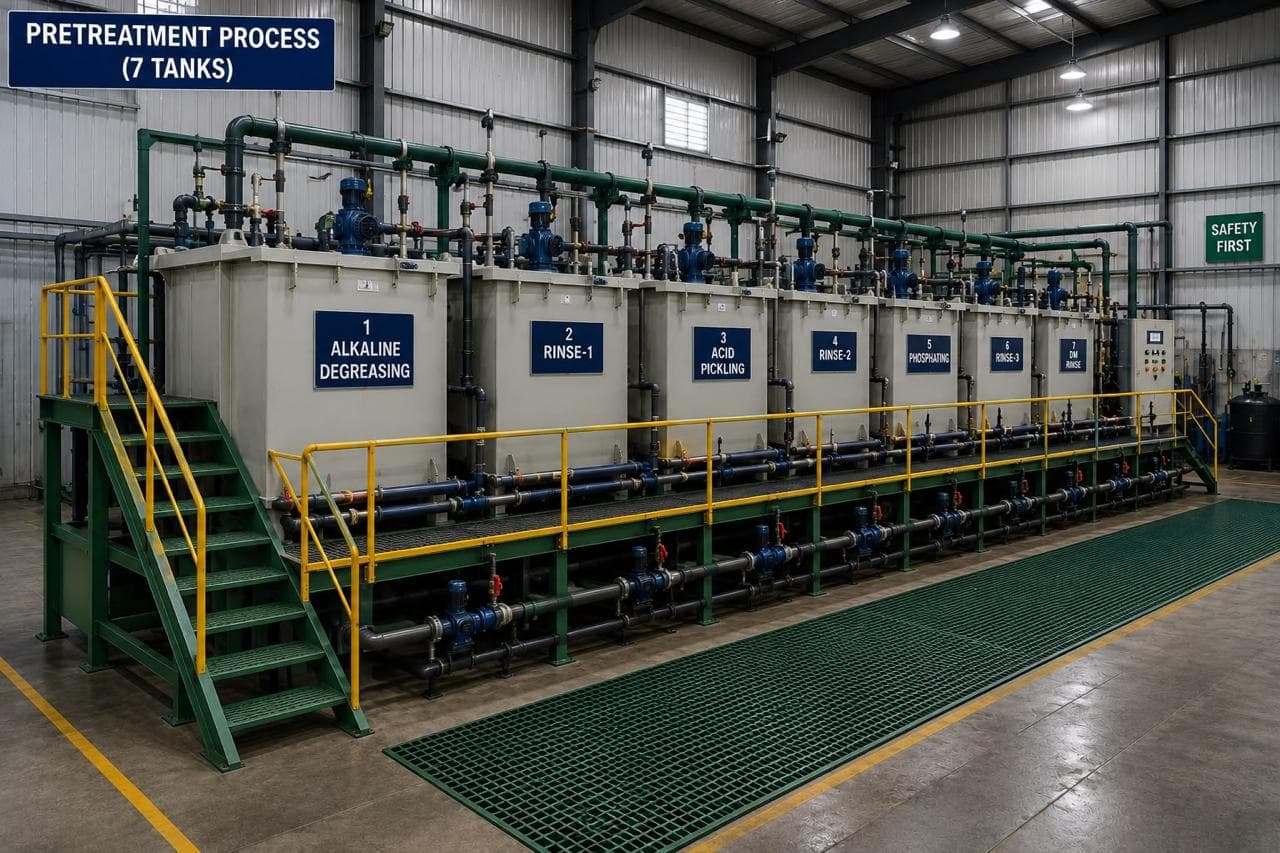
Ganesh works from 0.8 mm to 40 mm in mild steel, CRCA, stainless steel, aluminium, brass and copper, on presses from 20 T to 300 T, a 12 kW fibre laser with a 40 ft × 16 ft bed, and a 200 T, 4,450 mm 5-axis brake to 10 mm. Coated work passes through seven-tank pretreatment, a 16 ft × 16 ft shot blast chamber and an 18 ft × 14 ft powder booth, with dry film thickness and cross-hatch adhesion recorded. The works hold ISO 9001:2015 and ISO 14001:2015, and the environmental certificate is not decorative here: it governs how pretreatment chemistry, rinse water and the effluent treatment plant are controlled.
The record set that supports a REACH file is the mill certificate with the heat number, the alloy or grade actually supplied, the pretreatment and coating specification, and the coating batch. First article inspection and PPAP are available where a programme needs them, and the paint shop sets out the pretreatment and coating stages the finish declaration refers to.
The limits are worth stating. Ganesh does not manufacture the chemicals and cannot declare what a powder contains beyond the supplier's own documentation. Candidate list assessment of a finished assembly belongs to whoever places it on the market. And where a customer asks for a substance to be proven absent rather than declared absent, that is a laboratory test on a sample, with the sampling plan agreed before the coupon is cut.
What to put on the drawing and in the enquiry
- The alloy or grade with its standard, not just "MS" or "SS".
- The finish by chemistry and thickness, so the coating supplier's declaration can be matched to it.
- The list of bought-in components in the assembly, since each one is its own article.
- Any substance the customer prohibits outright, which is stricter than REACH and often the real requirement.
- The list version the declaration must reference, and the date by which it is needed.
- Whether the part is in prolonged skin contact, which triggers the nickel release question.
The pretreatment process article explains which stage fixes the surface chemistry that the coating declaration describes, and the degreasing guide covers the failure that most often forces a coating change mid-programme.
When REACH is the wrong frame
For anything that touches food, REACH is not the governing text; the food contact materials framework applies and asks for migration data, not composition. Medical devices, toys and packaging each have their own regime, and a REACH statement will not satisfy any of them.
For electrical equipment, RoHS sets the limits on ten substances by homogeneous material, and it is stricter than REACH for coatings because it does not allow dilution by the substrate. Most buyers need both, and the two statements answer different questions.
Where the customer asks for a PFAS-free declaration, be careful with the wording. A universal PFAS restriction has been under discussion at ECHA for several years and is not the same as a restriction in force, so the requirement is a customer specification, not a legal one. Ask for the test method and the limit before promising a result.
Send the drawing with the alloy, the finish and the component list on a quote request; the engineering team will return the route with the records that can actually be issued for the lot.
Frequently asked questions
Does a steel bracket need a REACH declaration?
If the bracket contains a candidate list substance above 0.1% by weight of the bracket, the recipient has to be told under Article 33. In practice most plain CRCA brackets contain nothing above the threshold, and the declaration is a short statement with the assessment date. Aluminium with a high lead content, brass with lead, and some plated or coated parts are where the answer changes.
Is a safety data sheet from the paint supplier enough?
No. A safety data sheet is written for a substance or a mixture, and it describes handling, not what remains in the cured film. Article 33 needs the substance name, where it sits in the article and how to use it safely. The data sheet is useful at the coating line; it is not the customer's compliance document.
How long does a supplier have to answer a consumer request?
Forty-five days under Article 33(2), and the information has to be free of charge. Business-to-business communication under Article 33(1) has to happen at the point of supply, so a part shipped without the statement cannot be fixed by a later email.
What is SCIP and who files it?
SCIP is the ECHA database of articles containing candidate list substances above 0.1%. Whoever places the article on the EU market files the notification, which since 5 January 2021 has been an obligation under the Waste Framework Directive. A fabricator supplying a component usually supports the customer's filing with data rather than filing it.
Does REACH ban lead in steel?
Not outright. Annex XVII entry 63 restricts lead above 0.05% by weight in articles supplied to the general public, with a list of derogations, and most structural and cold-reduced steels sit far below that. The tighter constraint on a machined or plated part usually comes from the customer's own list, not from REACH.
Sources and further reading
- Regulation (EC) No 1907/2006 concerning the Registration, Evaluation, Authorisation and Restriction of Chemicals (REACH) · reviewed 3 Nov 2026
- ECHA — Candidate List of substances of very high concern for authorisation · reviewed 3 Nov 2026
- ECHA — SCIP database of articles containing substances of very high concern · reviewed 3 Nov 2026
Need a material and coating record set for a REACH file?
Send the drawing, the finish specification and the list of bought-in components. We return the substrate and coating records the declaration is built from, and flag where a third-party test is the only defensible evidence.
Request a quote