Key takeaways
- A 500 kVA set rejecting about 300 kW to the radiator needs roughly 9 m³/s of air at a 30 K rise; at 5 m/s face velocity that is 1.8 m² of net free area.
- At 45% louvre free area, 1.8 m² of net area needs a 4 m² gross opening — four times the area a designer usually allows.
- Discharge air pulled back into the intake raises inlet temperature by 8–12 K and costs 3–6% of rated power before any other fault.
- Size the exhaust louvre 5–10% larger than the intake, because hot air expands and the discharge volume is higher.
- A canopy that passes a 25 °C factory test can derate at 45 °C on site with the same louvres, because the fan moves less mass at altitude and the radiator approaches its limit.
A canopy that passed its factory test at 25 °C arrives on a site where the afternoon air is 45 °C, the set is at 90% load, and the high coolant temperature alarm trips within an hour. Nothing has failed. The canopy was sized for a test cell, not for the site.
Canopy overheating is a heat balance problem with three inputs: the heat the radiator has to reject, the mass of air the fan can move against the canopy's resistance, and the temperature of the air entering the radiator. Get the first two right and the third wrong, and the set still derates. Get all three right and the canopy is unremarkable, which is the goal.
This guide works through the heat balance, the free area that follows from it, the recirculation and louvre faults that cause most site overheating, and what to put on the canopy drawing. The louvre geometry itself is covered in the canopy louvre panel design guide; this article is about the air the louvre has to pass.
How much heat does a canopy have to clear?
Start with the heat rejected to the cooling air, not the engine rating. For a diesel set, roughly 30% of fuel energy goes to the coolant and is rejected through the radiator, with another 5–10% lost to radiation and convection from the engine and alternator surfaces inside the canopy.
A 500 kVA set at 0.8 power factor produces 400 kW electrical. At about 40% overall efficiency, fuel input is roughly 1,000 kW. The coolant load is therefore around 300 kW, and the surfaces inside the canopy add 50–100 kW that the canopy ventilation has to remove. That second figure is the one designers forget: even with the radiator ducted to outside air, the alternator and exhaust lagging heat the enclosure.
The airflow needed to carry 300 kW at a 30 K rise is:
V̇ = Q ÷ (ρ × cp × ΔT) = 300 ÷ (1.1 × 1.005 × 30) = 9.0 m³/s
using air density at 45 °C of about 1.1 kg/m³ and cp of 1.005 kJ/kg·K. At a 20 K rise the same heat needs 13.6 m³/s, and at 40 K it needs 6.8 m³/s. A tighter rise means more air and a bigger opening; a wider rise means a smaller opening but a hotter radiator, which is limited by the coolant approach temperature.
The radiator supplier's fan curve gives the volumetric flow at a system resistance, not in free air. Add the louvre, the bird mesh, the radiator core and any duct, and read the operating point where the fan curve crosses the system curve. A fan quoted at 10 m³/s free air may deliver 8.5 m³/s through a canopy, and 7.5 m³/s at 45 °C and 600 m altitude.
How much louvre free area follows from the airflow?
Divide the airflow by the face velocity. Keep face velocity between 4 and 6 m/s: below 4 m/s the opening is larger than it needs to be, and above about 7 m/s rain separation fails and pressure drop climbs sharply.
At 9.0 m³/s and 5 m/s, net free area is 1.8 m². A pressed louvre bank at 45% free area therefore needs a gross opening of 1.8 ÷ 0.45 = 4.0 m². On a canopy side that is a 2,000 × 2,000 mm opening, which is larger than most 500 kVA canopy drawings allow.
That arithmetic is where most overheating starts. A designer allows a 1,200 × 800 mm louvre because it looks proportionate, which is 0.96 m² gross and 0.43 m² net at 45%. At 9.0 m³/s the face velocity through that net area is 21 m/s. The fan cannot get there: system resistance rises, flow falls, and the set derates. The louvre is not too small by a margin; it is too small by a factor of four.
Canopy airflow values and the Ganesh limit
The table collects the airflow and opening figures we check when a canopy drawing arrives. The right-hand column is what we can build and what we flag.
| Parameter | Typical value | Ganesh limit or note |
|---|---|---|
| Radiator heat rejection | 30% of fuel input | Use the OEM's published heat rejection, not an estimate from kVA |
| Air temperature rise | 20–40 K across the core | 30 K is the working default; below 20 K the opening grows fast |
| Face velocity at the louvre | 4–6 m/s | Above 7 m/s we flag rain carry-over and pressure drop |
| Louvre free area | 40–55% single bank, 30–40% double bank | Calculated from the CAD section, confirmed on first article |
| Intake gross opening | Net area ÷ free-area ratio | 4.0 m² gross for 1.8 m² net at 45% |
| Exhaust opening | 5–10% larger than intake | Hot air expands; a smaller exhaust throttles the set |
| Intake-to-exhaust separation | 1.5–2 m minimum | Below 1.5 m, recirculation raises inlet temperature 8–12 K |
| Altitude correction | About 3% flow loss per 300 m | A 600 m site loses roughly 6% of fan mass flow |
| Bird mesh | 12–13 mm aperture | Adds resistance; allow for it in the system curve |
| Louvre blade gap after coating | 8 mm minimum | Powder bridges a smaller gap and closes the slot |
| Panel flatness at the gasket | 1.5 mm over the frame face | A leaking joint bypasses the louvre entirely |
The exhaust row is the one that gets missed. A canopy with a 4 m² intake and a 3 m² exhaust has an asymmetric restriction, and the fan works against the smaller of the two. The discharge is also hotter and therefore larger in volume for the same mass flow, so the exhaust should be the larger opening, not the smaller.
Which failure modes cause canopy overheating?
The symptoms follow a pattern: the set is fine with the doors open, hot with them closed, and hotter still after an hour at load.
Recirculation
The exhaust plume leaves the discharge louvre and curls back into the intake because the two openings are on the same face or round a corner from each other. Inlet temperature rises 8–12 K, which on a typical OEM derate curve costs 3–6% of rated power, and the radiator's approach temperature narrows by the same amount.
The cure is geometric, not acoustic: separate the openings by 1.5–2 m, put them on opposite faces, or add a discharge duct that takes the plume away from the intake. A baffle between two openings on the same face helps, but a 300 mm baffle does not beat a 2 m/s crosswind.
Blocked or painted louvre
A louvre that was 45% free at the drawing can be 30% free after coating if the blade gap was under 8 mm, and 20% free after a season of dust and pollen. Bird mesh adds resistance and blocks with lint. Specify the gap after coating, make the mesh removable, and put the louvre on a service schedule.
Undersized exhaust
A canopy with a large intake and a small exhaust is common because the intake is sized for the radiator and the exhaust is sized to fit the remaining panel. The exhaust carries the same mass flow plus the combustion air, at a higher temperature, so it needs more volume. A 5–10% larger exhaust is the minimum; 15% is safer where the discharge is ducted.
Radiator ducted to the canopy, not outside
If the radiator draws air from inside the canopy and discharges inside it, the canopy becomes the plenum and every panel joint is an intake. The air heats with each pass, and the set reaches a new equilibrium at a higher temperature. Duct the radiator inlet and outlet through the canopy wall, with a canvas boot at the frame, and let the canopy ventilation handle only the engine and alternator surface heat.
Acoustic lining across the air path
Lining reduces the open area if it is fitted across a louvre or a duct, and it traps heat against the alternator if it is bonded to the wrong face. Keep the lining on the panels and off the air path, and terminate it at least 50 mm short of any opening so it cannot sag into the airflow.
Altitude and site ambient
A fan curve is measured at standard conditions. At 600 m the air density is about 6% lower, so the same volumetric flow carries 6% less mass and the heat rejection falls with it. At 45 °C the density is lower again. A canopy that is marginal at sea level is over the limit at 600 m and 45 °C, and the only fixes are more opening, a larger radiator or a lower load.
How do you diagnose an overheating canopy on site?
Measure four things before changing anything: ambient temperature at the intake face, air temperature at the radiator inlet, coolant temperature at the engine outlet, and the temperature at the exhaust louvre. The differences tell you which fault you have.
- Intake face 8–12 K above ambient: recirculation. Move the discharge or add a duct.
- Radiator inlet close to ambient but coolant hot: the radiator or the coolant circuit, not the canopy. Check the core for blockage and the fan for direction.
- Radiator inlet hot and exhaust hot: the canopy is short of free area. Measure face velocity at the louvre and compare with 5 m/s.
- Everything hot but the set is at low load: the canopy is acting as a plenum or the lining is blocking a path.
A handheld anemometer at the louvre face gives a face velocity reading in a minute. Multiply by the net free area and you have the volumetric flow, which is the number the fan curve was supposed to deliver. If the measured flow is 30% below the fan curve, the restriction is in the canopy, not the engine.
What the canopy build does at Ganesh
Louvre frames, blades and panel blanks are laser cut on the 12 kW fibre laser on the 40 ft × 16 ft bed, then formed on the 200 T, 5-axis brake with the 4,450 mm bed. The brake's 4,450 mm bed lets a louvre blade run the full width of a large canopy panel in one hit, which keeps the pitch consistent and the free area honest.
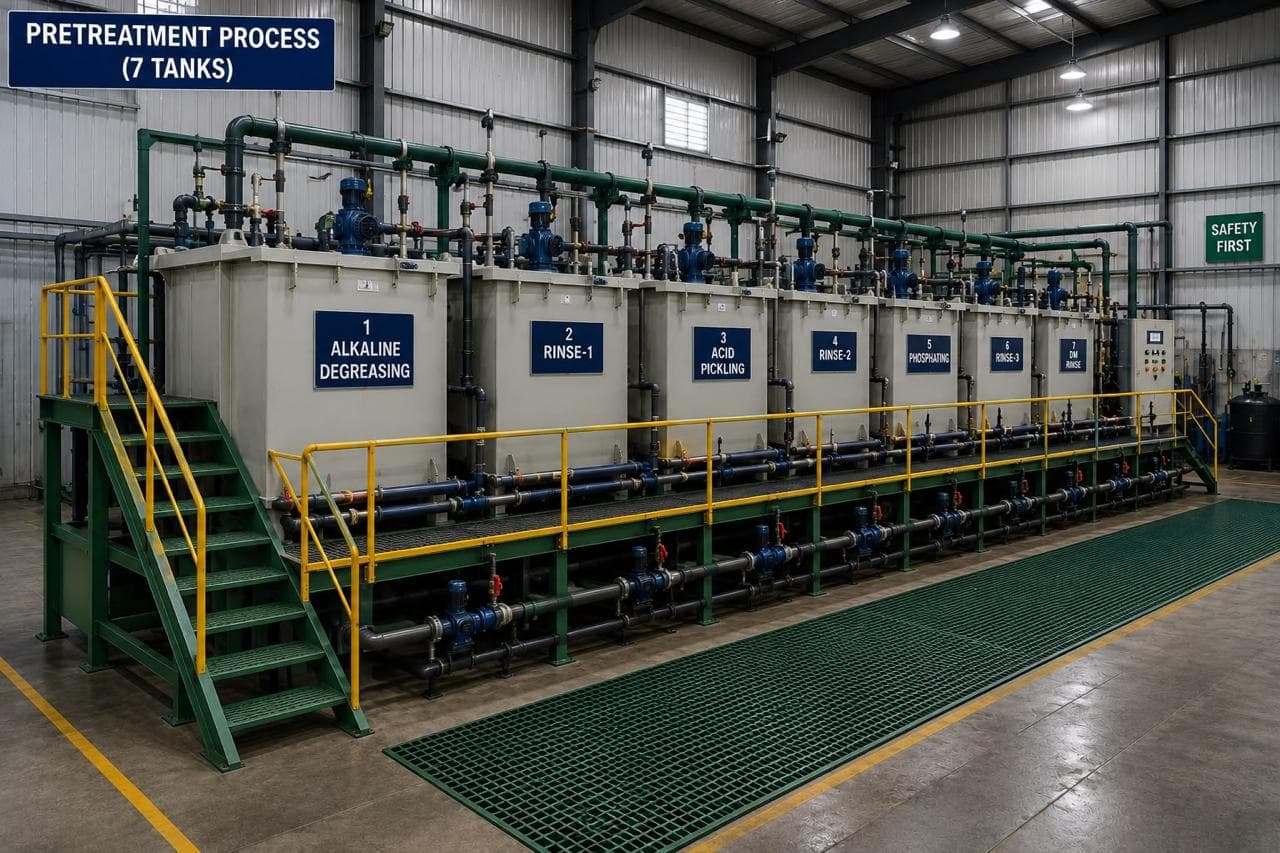
Louvre banks are welded or riveted in fixtures built in our tool room, with mid-span fixings every 500–600 mm so the blades do not flutter at fan frequency. Frames and canopy panels run through the 16 ft × 16 ft shot blast chamber where a profile is specified, the seven-tank pretreatment line, the 18 ft × 14 ft powder booth and the curing oven. DFT is checked on blade edges and frame faces, and the first article is checked for free area against the calculated figure, not the nominal opening.
The canopy as a whole — frame, panels, doors, louvres and base frame — is covered on the genset parts page. Mahindra Powerol is the canopy reference on our customer list, and the enclosure route is described in how a genset acoustic enclosure is manufactured. The genset and canopy hub collects the panel-level guides.
What the canopy drawing has to settle
- Heat rejection in kW at site ambient, from the radiator supplier, not derived from kVA.
- Fan curve and operating point, including the canopy, mesh and duct resistance.
- Net free area on intake and exhaust, with the calculation shown, and the gross opening dimensions.
- Face velocity at the design flow, with the limit stated.
- Intake and exhaust positions, with the separation dimension and any duct or baffle.
- Site ambient, altitude and load profile, because a 45 °C, 600 m site is a different canopy from a 25 °C test cell.
- Louvre blade gap after coating, stated as a minimum, and the mesh specification.
- Lining extent, with the air path kept clear and the lining terminated short of openings.
The canopy specification sheet carries these fields in the order the airflow calculation needs them, so the first quotation is checked against a heat balance rather than a panel count.
When a canopy cannot be cooled
Some sets cannot be cooled inside the enclosure they were specified with. If the required free area exceeds about 60% of the available wall, the louvre is no longer a louvre and the canopy needs a different layout: a larger footprint, a roof-mounted discharge, or a remote radiator with the canopy handling only the engine surfaces.
If the site is hot and dusty, a sealed canopy with a ducted radiator and a filtered inlet is often better than a larger louvre, because the filter can be serviced and the radiator stays clean. That is a different canopy with a different maintenance schedule, and it should be decided before the panels are drawn.
If the set is installed indoors with a plant-room intake, the canopy may be irrelevant and the room ventilation is the constraint. Measure the room, not just the canopy. A set that overheats in a plant room with the canopy doors open is a room airflow problem, and no louvre change will fix it.
We do not select the radiator, size the fan or certify the set's rating at site ambient. Those belong to the genset OEM. What we do is build the openings, louvres and panels to the free area the calculation requires, hold the gap and flatness tolerances that keep that area in service, and tell you when the opening on the drawing cannot deliver the airflow the set needs.
Send the set rating, the radiator data, the site conditions and the opening you have through request a quote, and the free area check comes back with the panel quotation.
Frequently asked questions
Why does my genset overheat only inside the canopy?
The canopy changes the fan's system resistance and can recirculate its own hot discharge. If the set runs cool with the doors open and hot with them closed, the louvre free area or the intake-to-exhaust separation is the cause.
How much free area does a 500 kVA canopy need?
About 1.8 m² of net free area for a radiator rejecting 300 kW at a 30 K rise, assuming 5 m/s face velocity. At 45% free area that is a 4 m² gross opening on the intake side.
Does a bigger louvre always cool better?
Up to a point. Beyond about 60% free area the blade overlap is too small to reject rain, and the panel stops being weatherproof. If more area is needed, add a second opening or duct the discharge.
How far should the exhaust be from the intake?
At least 1.5–2 m, or offset the two faces so the discharge plume does not cross the intake. Closer than that, the set pulls a measurable share of its own hot air back in.
Can insulation make overheating worse?
Yes, if it blocks the radiator or traps heat around the alternator. Acoustic lining belongs on the panels, not across the air path, and the lining edges must not reduce the free area.
Sources and further reading
- ISO 8528-1 — Generating sets, application, ratings and performance · reviewed 3 Nov 2026
- ISO 3046-1 — Reciprocating internal combustion engines, performance, declarations of power and fuel consumption · reviewed 3 Nov 2026
- Central Pollution Control Board — noise limits for diesel generator sets · reviewed 3 Nov 2026
Sizing a canopy for a hot site?
Send the set rating, the radiator airflow curve, the site ambient and altitude, and the opening you have. We will check free area and recirculation before quotation.
Request a quote