Key takeaways
- A 5 mm hole on an 8 mm pitch 60 degree staggered pattern gives 35.4 percent open area, which is the figure to put on an acoustic panel drawing.
- Louvre free area approximates pitch minus blade projection over pitch: a 30 mm blade at 45 degrees on a 50 mm pitch leaves about 58 percent.
- Laser beats a press tool while the pattern is still changing; at a USD 4,000 tool and a USD 2.50 piece-price gap the crossover is 1,600 pieces, so annual volume and model count decide.
- Ganesh laser cuts on a 12 kW machine with a 40 ft x 16 ft bed, forms to 4,450 mm, welds in three CLOOS cells and coats over seven-tank pretreatment.
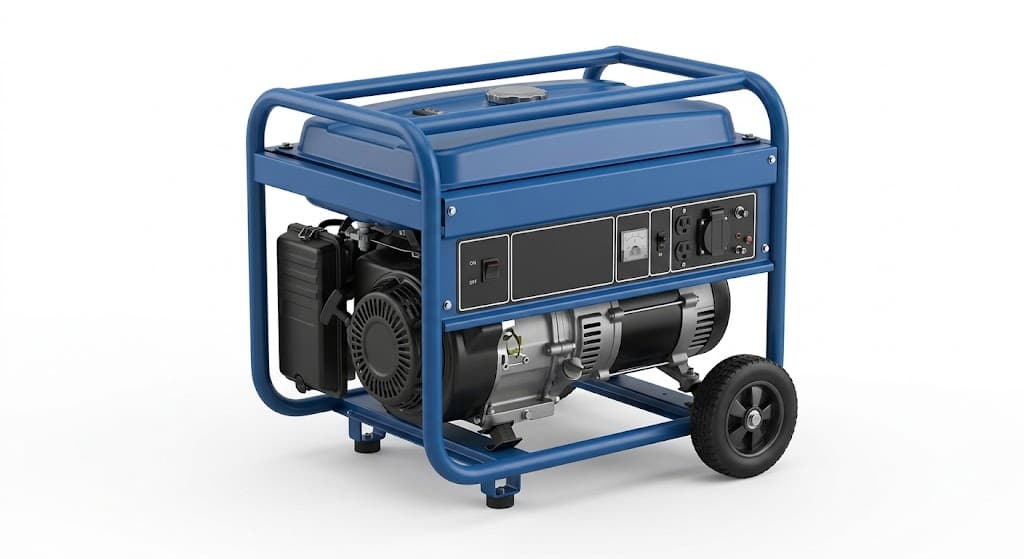
A genset canopy is a set of panels that must do four jobs at once: keep rain out, let cooling air in, hold acoustic infill, and open for service without a tool. A 500 kVA canopy and a 1,500 kVA canopy share a family resemblance and almost no parts, which is why laser-cut components for genset canopies have displaced punched panels in most medium-volume programmes. There is no tool to amortise, and a louvre pattern can change on a Monday without a die being cut.
The trade is that the drawing carries more responsibility. Open area, blade projection, panel thickness, edge condition and the treatment of every cut edge decide whether the canopy meets its acoustic and weather targets, and none of those are visible on a flat pattern. This article gives the arithmetic, the process limits and the coating detail that make a laser-cut canopy behave like a designed enclosure rather than a folded box. The part family sits in the genset and canopy hub.
Which canopy parts are laser cut?
The panels that change with rating are the ones a laser earns its place on: louvre panels for radiator and alternator airflow, perforated acoustic infill panels, side and end skins, access doors, roof panels, cable entry plates and the plates that retain acoustic foam. The base frame is a different story. It is heavier, welded and structural, and it is cut on the same machine only because the laser handles 6 mm plate as easily as 1.5 mm sheet.
A typical canopy breaks down into a skid base frame in 3-6 mm MS, four corner posts, removable side panels, two or three doors, louvre panels sized to the radiator face, a roof with lifting points, and a cable entry box with a removable plate. Each of those has a different tolerance driver: the frame carries the engine, the panels have to align at the seams, the doors have to swing without rubbing, and the louvre blade angle has to shed water at the design wind.
Cutting all of them on one machine means the joint between a panel and the frame can be toleranced as a pair rather than negotiated later. That is worth more than the cut price, because the commonest canopy complaint in service is not corrosion, it is a door that rubs a panel after a year of vibration.
How do the panels line up with the base frame?
The frame is the datum and the panels follow it, so the frame drawing decides whether the canopy closes cleanly. Put the corner post positions, the panel mount hole pitch and the door hinge axis on the frame drawing, and dimension the panel edges and louvre openings back to those same points. A panel toleranced to its own outer edge will fit the frame it was modelled on and fight the one that was welded.
Allow the seam gap explicitly. A welded frame can be 3 mm out on a 2,000 mm diagonal without being wrong, and a panel cut to plus or minus 0.5 mm adds to that stack; a 2-3 mm nominal seam gap absorbs both without a shim. If the gap is drawn at zero, the assembler either reworks the panel or forces it, and the paint cracks at the fixing within a season. The welding side of the interface is covered in welded genset base frames.
How much open area does a panel actually have?
Open area is a calculation, not an opinion, and it should be on the drawing with a tolerance. For a staggered perforation, with hole diameter d, pitch p and rows at 60 degrees, open area is the hole area divided by the area of one parallelogram cell:
Open area = (0.785 x d squared) / (p squared x 0.866)
At d = 5 mm and p = 8 mm, that is 19.63 / (64 x 0.866) = 19.63 / 55.4 = 35.4 percent. The same pattern at 10 mm pitch gives 22.7 percent, and at 6 mm pitch gives 63 percent, which is closer to a grille than an acoustic facing. Recording the number rather than the pitch is what lets an acoustic engineer and a fabricator agree on the same panel.
Louvres use a different rule. Free area is approximately pitch minus blade vertical projection, divided by pitch. A 50 mm pitch with a 30 mm blade set at 45 degrees has a vertical projection of 30 x 0.707 = 21.2 mm, leaving 28.8 mm of the 50 mm pitch open, or about 58 percent. Change to a 40 mm blade at 45 degrees and free area drops to 43 percent: less airflow, better rain rejection, and a different cooling calculation. Both are valid designs; the drawing has to say which one it is.
The acoustic layer has its own geometry. Infill sits behind a perforated facing, and the facing, the retention clips and the foam thickness all consume depth inside the canopy. If the frame is drawn for a 25 mm foam and the acoustic supplier delivers 50 mm, the facing plate no longer lies flat and the louvre clearance changes. Fix the foam thickness, the stand-off and the clip type on the drawing, and keep the lower edge of the foam above the sill so water can drain past it.
Panel and process limits
| Feature | Typical canopy value | Ganesh limit or note |
|---|---|---|
| Side and end panel | 1.2-2.0 mm CRCA | 0.8-40 mm across custom parts; laser cuts to 20 mm |
| Louvre blade | 1.5-2.0 mm, 25-40 mm wide | Cut and formed from one blank on a 200 T, 5-axis brake, 4,450 mm bed |
| Perforated acoustic facing | 30-40 percent open area | Laser-cut holes from 3 mm; pitch held on the flat pattern |
| Panel size | Up to 3,000 x 1,500 mm | 40 ft x 16 ft bed, 12,192 x 4,877 mm, takes larger |
| Longest formed edge | 4,450 mm | Bed limit on the press brake |
| Base frame | 3-6 mm MS, welded | Laser to 20 mm; three CLOOS robotic MIG cells plus 30+ manual stations |
| Panel tolerance | Plus or minus 0.5 mm | Typical; door and hinge positions named separately |
| Coating | Powder, 60-90 micrometre DFT | Seven-tank pretreatment, 16 ft x 16 ft blast chamber, 18 ft x 14 ft powder booth |
| Film check | DFT gauge and cross-hatch | Tested on every batch, not on a sample from the first shift |
Why do canopy panels fail after two monsoons?
The first failure is at the cut edge. A laser-cut edge is square and sharp, and powder pulls away from a sharp corner during cure, so the film is thinnest exactly where water sits. On a louvre blade that edge faces the weather. Deburring, a small radius on the blade or a bead blast before pretreatment all give the film something to hold, and the seven-tank line's conversion coating does the rest of the work.
The second is water tracking. A louvre that sheds rain at the blade still passes a film of water down the inner face when the genset runs in a crosswind, and if the acoustic foam sits against that face it wets and stops absorbing. A stand-off, a drain path and a lower foam edge above the sill solve it; a solid gasket does not, because it traps the water instead.
The third is panel drumming and seam fatigue. A large flat panel with no return flange vibrates at its own frequency, the seam frets, and the powder at the seam cracks. A 15-20 mm return on every free edge stiffens the panel and gives the powder a place to break at an internal corner rather than a sharp outside edge.
The fourth is door sag. A canopy door 1,200 mm tall hangs on two hinges fixed through a 1.5 mm skin, and after a year of vibration the skin around the lower hinge distorts and the door drops 2-3 mm until it rubs the sill. A 3 mm reinforcement plate behind each hinge, spot welded or riveted to the frame rather than the skin, costs little at build and removes the complaint entirely. Specify the plate on the drawing, because a fabricator will not add material that is not asked for.
When does laser beat a press tool on a canopy panel?
The crossover is arithmetic. Take a side panel with a louvre pattern where a press tool costs USD 4,000 and the laser piece price is USD 12.00 against USD 9.50 from a tool. The saving is USD 2.50 per piece, so the tool pays back at 1,600 pieces; below that the laser is cheaper, and the tool also locks the pattern.
Two practical corrections apply. A canopy family with three ratings and two custom variants may never run 1,600 identical panels of one pattern, which is why laser usually wins even on large programmes. And tooling is quoted separately from piece price, so the crossover belongs in the buyer's own model rather than in a supplier's comparison table. Ganesh quotes press tooling, progressive dies and fixtures from the in-house tool room as a separate line, which lets the calculation be done honestly.
What Ganesh runs for genset canopies?
Ganesh supplies genset canopy steelwork to Mahindra Powerol, alongside base frames, panels and brackets for the wider genset programme. Panels come off the 12 kW fibre laser or one of the two 6 kW and two 3 kW support machines, are bent on the 200 T 5-axis brake, and are welded in a CLOOS cell or at a manual station. From there the route is blast, seven-tank pretreatment and powder coating in the 18 ft x 14 ft booth, with DFT and cross-hatch adhesion checks before dispatch.
Fixtures, checking fixtures and press tools are built in the tool room, and the plants hold ISO 9001:2015 and ISO 14001:2015. The genset parts page lists the part families, and powder coating failure on outdoor enclosures covers what happens when the edge preparation is skipped.
What belongs on the canopy panel drawing?
- Panel material and thickness, with the grade standard named for the Indian mill.
- Louvre pitch, blade width and blade angle, plus the free area percentage and its tolerance.
- Perforation diameter, pitch and pattern, with open area stated rather than left to be counted.
- Door and hinge positions dimensioned from the same datum as the frame mounts, with a reinforcement plate called out.
- Return flange size on every free edge, and the seam or overlap detail.
- Cable entry size, plate thickness and gland plate fixing.
- Coating system, corrosivity category, DFT range and masking of mating faces and earth points.
- Labelling position, and whether the panel is handed or common.
The canopy RFQ checklist turns that list into a submission, and bending for genset canopies and panels covers the forming step that follows cutting.
When is a laser-cut steel canopy the wrong choice?
A moulded composite or cast aluminium canopy is a different product, and no amount of sheet metal work will match its tooling economics at high volume with a frozen design. Stainless canopies are technically possible on the laser, but the weld finishing and the cost of the sheet change the commercial case, so they should be quoted as a separate programme rather than as a variant of the mild steel one.
Ganesh does not supply the engine, alternator, controller, acoustic foam, silencer or the acoustic test certificate, and does not measure canopy sound pressure level. The OEM owns the acoustic performance, the rating and the site condition; the fabricator's evidence is dimensional, weld and coating data against the drawing. If a canopy drawing shows an attenuation target with no panel or louvre specification behind it, the first thing to fix is the panel, not the supplier.
Frequently asked questions
What open area should a genset canopy acoustic panel have?
Most acoustic infill panels run between 30 and 40 percent open area so sound reaches the absorbent layer without the sheet reflecting it. A 5 mm hole on an 8 mm pitch at 60 degrees gives 35.4 percent, which is a good starting point to put on the drawing with a tolerance of plus or minus 3 percent.
How much free area does a canopy louvre need?
Free area falls as the blade gets wider or steeper. With a 50 mm louvre pitch and a 30 mm blade set at 45 degrees, the vertical projection is 21.2 mm, so free area is about 58 percent. A 40 mm blade on the same pitch drops it to 43 percent, which changes both cooling airflow and rain protection.
Why does powder coating fail on canopy louvre edges?
A laser-cut louvre edge is sharp, so the powder film thins over the corner during curing, and the edge rusts first. Deburring or a small radius on the blade edge, a phosphate conversion coating in the seven-tank line and a minimum DFT on the edge are the usual fixes.
Should canopy panels be laser cut or punched?
Laser while the louvre pattern, door cut-out or cable entry changes with each rating or customer. Once a panel is frozen and annual volume passes the tooling crossover, which in the worked example is 1,600 pieces at a USD 4,000 tool, a press tool on a 250 T press becomes cheaper per piece.
Does Ganesh supply a complete canopy or only the sheet metal?
Ganesh supplies the steelwork: base frame, side and end panels, doors, louvre panels, roof, cable entry plates and acoustic retention parts, cut, formed, welded and coated to the OEM drawing. The engine, alternator, controller, acoustic foam and the acoustic test certificate stay with the genset OEM.
Sources
Send a canopy panel drawing for review
Attach the louvre or perforation pattern, panel thickness, base frame detail and coating category. We review the cut, form, weld and coating route before quoting.
Send a drawing