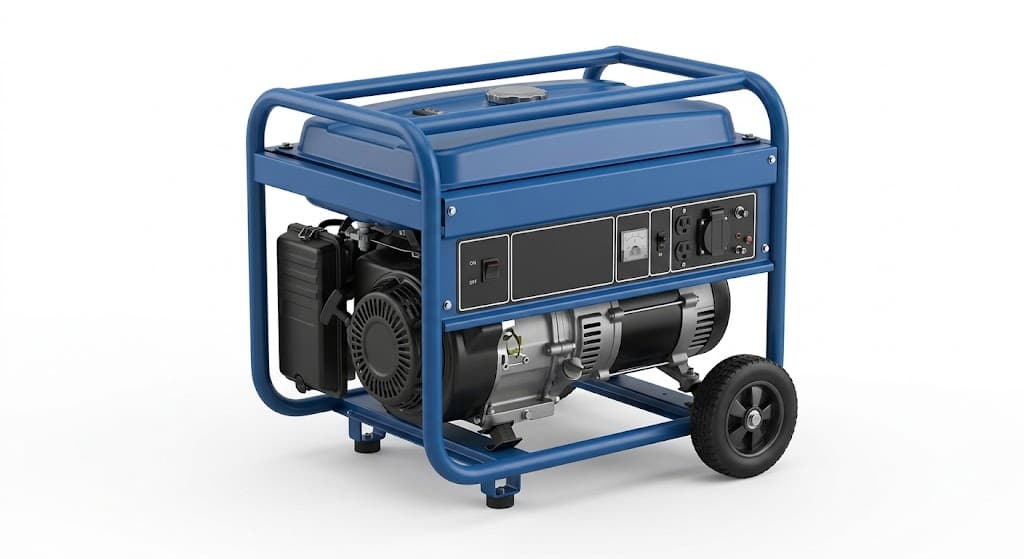
Key takeaways
- Keep the inside radius at 1t or more on 2 mm CRCA canopy skins; a 0.5t radius cracks the powder film at the bend within one monsoon.
- A 25–30 mm return on all four edges is the minimum that lets a canopy side bolt to the frame without oil-canning; long sides formed on the 4,450 mm bed stay in one piece up to about 4,300 mm.
- Corner reliefs must clear the bend allowance on both legs, or the fourth bend pulls the corner out of square by 2–3 mm.
- Specify 60–80 µm dry film thickness and check it on the flat as well as the bend, because a 1t bend loses 15–20% of film thickness at the outside radius.
A genset canopy fails at the bend before it fails anywhere else. The corner that will not close, the door that will not seal, the paint that cracks along a fold after the first monsoon — all three start with a radius, a return depth or a relief notch that was drawn for a flat part and never checked for a folded one. The canopy skin is the largest visible surface on the product, and it is also the panel with the least tolerance for a forming error.
This page covers bending for genset canopies and panels: what radius to hold, how deep the returns need to be, where the corner relief goes, and how the coating behaves over a fold. It is part of the genset, canopy and acoustic enclosure guides. The welded base frame underneath the canopy is a different problem, covered in welded genset base frames, and the acoustic performance of the finished enclosure is set by the panel construction described here.
What radius should a canopy skin be bent to?
Use an inside radius of 1t minimum on 1.6–2 mm CRCA, and 1.5t to 2t on any face that will be powder coated and seen. The bend itself will survive at 0.5t; the coating will not. On a 1t bend the outside fibre of a 2 mm sheet stretches by about 33%, and the powder film on that fibre thins by 15–20% because it stretches with the steel. At 0.5t the film thins further and the bend line becomes the first place corrosion starts.
The practical figure for canopy work is R2 on 2 mm, formed over a 16 mm V die. That gives a radius close to 0.16 × 16 = 2.6 mm in air bending, which sits comfortably inside the crack-free and coat-safe range. Drawing R2 and forming over a 12 mm die produces R1.9 and a tighter strain path than the drawing implies; specifying the die opening removes the ambiguity.
A radius under 1t usually needs a smaller punch and a slower ram, and sometimes two hits, and the second hit is where the panel gets a mark on the visible face. A design change from R1 to R2 costs nothing in material and removes a step from the route.
How deep do returns and flanges need to be?
A 2 mm canopy side bolting to a frame needs 25–30 mm of return on all four edges; an acoustic panel that carries 25 mm or 50 mm of infill needs 40 mm or more so the infill has something to sit against. Two forces set the number. The first is the fastener: a 6 mm bolt with a washer needs 16 mm of flat plus edge distance, and edge distance under 1.5 × hole diameter tears out under vibration. The second is stiffness: a 30 mm return turns a flat sheet into a shallow channel and raises the panel's resistance to oil-canning far more than adding 0.2 mm of thickness does.
The thickness comparison is worth running before specifying 2.5 mm sheet to fix a drumming panel. Doubling thickness from 1.6 mm to 3.2 mm quadruples bending stiffness but also doubles weight and increases the bend force; adding a 30 mm return costs one extra bend and a few grams. For a canopy side that is 2,000 mm × 1,200 mm, the return plus two shallow beads is almost always the cheaper fix.
What bending for genset canopies and panels has to deliver
Values below are the working figures for canopy skins, louvre frames and access doors in CRCA. The Ganesh column states where the limit comes from on our equipment.
| Feature | Typical specification | Ganesh limit or note |
|---|---|---|
| Skin thickness | 1.6 mm or 2 mm CRCA | 0.8–40 mm range for custom parts; 10 mm on the CNC brake |
| Inside radius, coated face | 1t minimum, 2t preferred | Air bend over 16 mm V die gives R2.6 on 2 mm |
| Return depth, bolted edge | 25–30 mm | Below 20 mm, forming needs special tooling |
| Return depth, acoustic panel | 40–50 mm for 25–50 mm infill | Set by infill thickness plus 10 mm |
| Maximum panel length, one piece | 4,300 mm | 4,450 mm bed; laser cuts the blank on a 40 ft × 16 ft bed |
| Corner relief width | Bend allowance + 0.5 mm each side | Relief must clear both legs or the corner pulls 2–3 mm |
| Stiffening bead | 3–5 mm deep, 15–20 mm wide | Beads must not cross a gasket line |
| Louvre blade angle | 30–45° from horizontal | Folded, not welded; blade pitch sets free area |
| Door gasket flange | Double return, 12 mm + 12 mm | Holds a bulb seal without a separate retainer |
| Dry film thickness | 60–80 µm powder | DFT gauge on flat and on bend; cross-hatch adhesion per batch |
Corner reliefs, bend sequence and the fourth bend
A canopy side is a shallow tray: four bends, each with a return on the adjacent edge. The corners are where the sequence matters. If the relief notch is cut only to the bend line, the material left in the corner is stretched by the first two bends and then has nowhere to go on the third and fourth, so the corner lifts and the panel goes out of square. The relief has to clear the bend allowance plus a small clearance — on 2 mm CRCA with R2, roughly 5 mm each leg, cut as an L rather than a slot.
The sequence is chosen so that the last bend has the shortest flange and the least tool access. On a tray 2,000 mm × 1,200 mm, the two long sides are formed first while the panel is still flat enough to handle, then the two short sides, then any internal returns around the door aperture. Each bend is checked for angle before the next one is started, because correcting a corner after four bends means reworking the whole panel.
Two-bend corners, where the returns meet at 45°, are a design choice. They seal better and look better on a visible corner, but they add a miter cut and a weld per corner, and the weld has to be dressed before coating or the powder shows the seam. Bolted corner posts are faster and allow the panels to be replaced on site, which matters for a canopy that has to be serviced.
Louvre frames, doors and the parts that move
A louvre frame is a folded picture frame with mitred corners, usually 1.6 mm or 2 mm, with the blades folded separately at 30–45° and riveted or welded in. The frame's return depth sets how much of the blade edge is hidden, and the blade pitch sets the free area. A louvre at 45° with a pitch equal to the blade width gives roughly 50% free area; reduce the pitch and the free area falls, which raises the air velocity through the opening and the pressure drop the radiator fan has to work against. If the acoustic target needs a baffle behind the louvre, the frame needs another 50 mm of depth.
Access doors are where bend tolerance shows up as a service problem. The door is a tray with a double return on the hinge side and a single return on the latch side, and the gap to the frame is set by the bend positions on both parts. A ±0.5 mm error on each of four bends is ±2 mm at the gap, which is the difference between a 3 mm door gap and a whistling one. Specify the gap after coating, and let the supplier hold the door and frame as a matched pair from the same bend programme.
Sealing, gaskets and the panel joint
A canopy is only weatherproof if the joints between folded panels are sealed, and the bend geometry decides whether a gasket has anywhere to sit. The usual arrangement is a return on one panel that overlaps the flat face of the next, with a closed-cell EPDM or neoprene strip compressed to 25–30% of its thickness. A 3 mm gasket needs a 1 mm step or a flange wide enough to keep it in place while the panel is offered up; a return that is 1 mm short of the gasket line means the strip sits on the bend radius and seals on a curve.
Roof panels need a slope of at least 1–2° away from the door, and the bend that creates the slope has to be formed across the full width in one hit. Forming it in two halves leaves a step at the middle that holds water. The laser-cut components for genset canopies note covers how the blank is nested so the joint, the gasket line and the holes stay in one datum.
Coating over a fold
Canopy panels are pretreated in seven tanks, blasted where the specification calls for it, and powder coated. The bend affects all three stages. A tight radius traps pretreatment chemistry in the corner if the panel is not drained properly, and the trapped chemistry shows as a blister under the powder months later. A sharp fold also creates a shadow in the powder booth, so the film on the inside of a return is thinner than on the flat.
Two controls fix it: a radius of 1t or more everywhere the panel will be seen, and a DFT reading on the bend and inside the return, not only on the flat face. A canopy is an outdoor product, so the coating system has to match the corrosivity category the site actually has. Why powder coating fails on outdoor enclosures sets out the failure modes; the bend is one of the four that appear most often.
What Ganesh runs
Canopy work uses the same route as the rest of the enclosure business. A blank for a 4,300 mm side is nested as one part on the 40 ft × 16 ft laser table, formed on the 200 T brake and welded in a fixture; nothing about a canopy needs a different machine, only a different sequence. Forming uses the 4,450 mm bed with Delem control, and the bend programme is stored against the part number so the next release runs the sequence that was approved.
Welding is on the CLOOS cells or at the manual stations, with the fixtures made in-house so the frame stays square through the weld instead of being pulled back afterwards. Finishing stays on site: seven-tank pretreatment, a 16 ft × 16 ft blast chamber, an 18 ft × 14 ft electrostatic booth and a curing oven, with DFT and cross-hatch adhesion testing in process. A canopy panel therefore does not leave the site between forming and coating, which is why a bend that needs rework is found before the powder goes on. Genset and canopy parts are supplied to Mahindra Powerol, and the plants hold ISO 9001:2015 and ISO 14001:2015.
What to put on the canopy drawing
- Skin thickness with tolerance, and the grade — CRCA grades behave differently at the same thickness.
- Inside radius per bend, with the die opening implied or stated.
- Return depths, and which returns carry the acoustic infill.
- Corner relief dimensions, or a note that the supplier may set them.
- Door and frame gap measured after coating, with the seal type.
- Louvre blade angle, pitch and free area, plus the baffle depth if one is fitted.
- Bead or swage positions, and the surfaces that must stay flat for gaskets.
- Coating system: pretreatment, powder or wet paint, DFT range and the corrosivity category.
The canopy RFQ checklist covers the acoustic target, louvre free area and base frame items that a bend drawing does not capture, and the genset parts page shows the panel and frame types we build.
When a folded canopy is the wrong route
A canopy that has to be lifted by its own frame, or that carries the alternator and radiator loads, needs a welded structural base frame rather than folded panels; the bend rules above apply to the skin, not to the load path. Very small canopies below about 600 mm across are often built as a single folded shell with a removable end panel, and the fold sequence becomes the whole design.
Above 3 mm, folded canopy panels need press forming or a fabricated section, and above 10 mm the brake is out of scope. And if the acoustic target is below what a 50 mm infill panel can reach in the space available, the answer is a different enclosure architecture, not a heavier skin. Send the panel drawings, the acoustic target and the coating specification together; the bend geometry and the enclosure performance are decided in the same review. Start at request a quote, and the forming route is described on the CNC press brake bending page.
Frequently asked questions
What thickness is a genset canopy panel normally made from?
Most canopy skins are 1.6 mm or 2 mm CRCA. Below 1.6 mm the panel drums and dents in service; above 3 mm the weight and the bend force stop being worthwhile unless the panel is structural.
How deep should the return flange be on a canopy side?
25–30 mm for a 2 mm skin that bolts to a frame, and 40 mm where the return also carries the acoustic infill. Shorter returns leave no room for a rivet or bolt head and the panel oil-cans between fixings.
Why does the powder coat crack along the bend on a canopy?
Because the outside radius is too tight for the film to stretch. Below 1t on 2 mm CRCA the coating thins to half its flat thickness at the bend and cracks in service. Increase the radius to 2t, or specify a flexible powder.
Can you form a canopy panel longer than 4 m?
Up to about 4,300 mm on the 4,450 mm bed in one piece. Longer canopies use a designed joint behind a louvre or a corner post, so the seam is not on a visible face.
Do louvre blades need to be formed or cut?
Both. The blade profile is usually cut flat and folded along two lines at 30–45°, with the frame formed separately. A folded blade holds its angle better than a welded one and does not distort the louvre opening.
Sources
Send the canopy drawing with the bend table
Attach the panel drawings, acoustic target and coating specification. We review return depths, corner reliefs and the forming sequence before quoting.
Send a drawing