Key takeaways
- A 0.8 mm mild steel panel weighs 6.28 kg/m², so a 300-panel stack of 0.6 m² covers carries 1,130 kg — and the bottom part, not the carton, is what dents first unless the load is carried by the pack.
- Size the pack to three load cases: stacking, road vibration at 3–50 Hz, and moisture. A pack that ignores one of them fails on the case it ignores.
- Stretch film applied at more than about 20% elongation pulls a freshly cured powder film into contact with itself and marrs it; interleave, do not over-tension.
- A sealed wrap without desiccant traps the moisture that was in the pallet and the air, and condensation at a 10 °C night-time drop does more corrosion damage than an open pack.
- Packaging should cost 0.5–2% of part value; above that the pack is usually compensating for a handling problem that belongs upstream.
A 0.8 mm mild steel panel weighs 6.28 kg per square metre. Stack three hundred of them at 0.6 m² each and the bottom panel is carrying 1,130 kg across an area the size of a desk. Nothing about the journey damages that panel; the stack does, in the first hour in the dispatch bay.
Packaging for transit is usually discussed as if distance were the enemy. In practice the damage arrives from four directions: compression from the stack, vibration and abrasion from the road, moisture from the air, and handling at both docks. A pack that addresses distance with more wrapping and ignores compression will still deliver dented parts, and it will cost more doing it.
This page sets out how to size a pack to the part, the arithmetic behind stacking and vibration, the film and desiccant rules that stop condensation, and the signs that a pack has crossed from protection into over-packing. The storage half of the same problem is covered in warehouse and WIP control.
What actually damages parts in transit?
Compression is the first cause and the least discussed. Corrugated cartons lose about 50% of their compression strength at 90% relative humidity over a month, which is an ordinary monsoon in a non-air-conditioned warehouse, and a stack designed on a dry-day figure fails in the first wet week.
Vibration is the second. A truck on an Indian highway produces 1–5 g of vertical acceleration between 3 and 50 Hz, and a panel stack strapped rigidly to a pallet transmits all of it into the edges. Parts that are free to move abrade; parts that cannot move at all fatigue at the holes.
Abrasion is the third. Two powder-coated panels touching face to face under a 300 kg load will rub through the film at the corners within a few hundred kilometres, and the damage is a grey smear that reads as a coating defect and is not one.
Moisture is the fourth, and it is the one that hides. A pack sealed in a warm shop, then cooled overnight on a truck, condenses water on the inside of the film. Bare or phosphated steel that is not protected starts to corrode within days, and the customer opens the box to find rust on parts that were perfect at dispatch.
| Element | Typical specification | Protects against | Ganesh limit or note |
|---|---|---|---|
| Carton board | 5-ply, 120 g/m² liners, ECT 32 lb/in | compression, abrasion | rated at 90% RH, not dry |
| Pallet | 1,200 × 1,000 mm, four-way, 1,000 kg static | handling, stack stability | checked before every dispatch |
| Corner protection | 3 mm angle board, full height | edge dents, strap cutting | on every stack of panels |
| Interleaving | 1 mm EPE foam or kraft | face-to-face abrasion | between painted faces |
| Stretch film | 23 µm, 2 wraps plus top sheet | dust, moisture, load shift | applied loose, under 20% stretch |
| VCI film | 80 µm, sealed | condensation corrosion | bare and phosphated steel |
| Desiccant | 1–2 kg silica gel per sealed pack | condensation inside the wrap | sized to barrier area and days |
| Strapping | 19 mm PET, edge protectors under | load shift | tensioned to hold, not to crush |
| Stack height | 4–6 layers per pack | bottom-part deformation | set by part stiffness |
| Pack cost | 0.5–2% of part value | — | above 2%, check the handling |
Packaging for transit: sizing the pack to the stack
The pack has to carry the stack, not merely contain it. Work out the load on the bottom layer first: the number of parts above it, multiplied by the part mass, plus the pallet and the packaging, distributed over the bearing area.
Take the 300-panel case again. Twelve packs of 25 panels each, stacked four high on a pallet, puts 100 panels above the bottom one — 628 kg per 0.6 m², which is 1,047 kg/m². A 5-ply carton with an edge crush test of 32 lb/in carries roughly 400–500 kg in a four-high stack under dry conditions and less than half that in a humid warehouse.
That is the calculation that decides between a carton and a crate, and it takes two minutes. Where the load exceeds the carton rating, the options are fewer layers per pack, a heavier board, an internal partition that carries load to the pallet, or a crate. Adding foam does not help; foam protects faces, not the stack.
Parts also deform under their own stack before the carton does. A flat panel with a large unsupported span oil-cans under a distributed load and springs back with a visible shadow, which reads as a flatness failure on the customer's incoming inspection. Support the panel near its stiffest feature, keep the span short, and do not stack painted faces directly against each other without interleaving.
Pack quantity and the line-side dock
The quantity per pack is a production decision disguised as a packaging one. A pack that is too large sits in the customer's store half-open, gathering dust and damage; a pack that is too small multiplies the unpacking labour at the line.
Work it from consumption rather than from the pallet footprint. If the customer's line consumes 200 panels a day and a pack holds 25, the dock handles eight packs a day, each needing about six minutes to open, cut down and dispose of — 48 minutes of handling for one part number. Halving the pack size doubles that labour, which is why the customer's material handling team, not the supplier's dispatch bay, should set the number.
The pallet height matters too. A pack built to 1,600 mm fits a standard rack and cannot be lifted by a manual stacker. A pack at 1,100 mm fits both, and the extra pallets it generates are cheaper than the reach truck the taller pack requires.
This is the point where a packaging conversation becomes a supply-chain one. Pack quantity, delivery frequency and the receiving method are one decision, and they belong in the same discussion as the release schedule.
Vibration, strapping and the edge
A strapped stack is a rigid body, and a rigid body transfers road input straight to the part edges. Two things reduce it: strapping at the right tension, and edge protection under every strap.
Strapping should hold the stack together, not compress it. A 19 mm PET strap tensioned until the corner board creases is loading the panel edge at several hundred kilograms, and the first pothole adds a dynamic peak on top. Angle board spreads that load over 40 mm instead of 2 mm, which is why it is specified on every stack of painted panels rather than only on the expensive ones.
Vibration testing to ISO 4180 gives a schedule for a filled package, and ISO 2233 defines the conditioning before the test — 24 hours at a stated temperature and humidity. A pack tested dry and shipped in a monsoon has not been tested. If a customer specifies a drop or vibration test, the conditioning is part of the specification, and it belongs in the purchase order.
Moisture: VCI, desiccant and the sealed pack
Bare and phosphated steel needs protection from condensation, and the mechanism is a temperature swing rather than rain. Air at 30 °C and 70% relative humidity holds about 21 g of water per cubic metre. Cool that air to 20 °C inside a sealed pack and it can hold 15 g, so 6 g per cubic metre condenses on the coldest surface, which is the steel. The corrosion that follows is covered in why powder coating fails on outdoor enclosures.
Volatile corrosion inhibitor film releases a vapour that adsorbs on the metal and slows the corrosion reaction. It works in a sealed pack and stops working in a pack that is opened and closed, and it has to be within 300 mm of the surface it protects. A VCI sheet draped over the top of a stack protects the top panel and nothing else.
Desiccant removes the water that enters through the film and the water that was sealed in. Two kilograms of silica gel absorbs about 200 g at 40% relative humidity, which covers roughly 1 g/m²/day of ingress through 2 m² of film over three months, with margin for the pallet, which holds moisture in the wood.
Do not combine the two carelessly. A VCI film with a desiccant bag inside is fine; a VCI film inside a sealed polyethylene wrap with wet pallet wood is not, because the wood releases water into a space the VCI cannot dry. Dry the pallet, or use a plastic pallet for the long-storage packs.
Where over-packing starts to cost more than it saves
Over-packing has a signature. The pack takes more than ten minutes per pallet to open. The customer's store has to dispose of more packaging mass than the parts weigh. The pack is bigger than the rack it lands on. And the parts still arrive damaged, because the extra material went into wrapping rather than into the load path.
The cost is real on both sides. Pack material at 3–4% of part value is common on over-specified jobs, and the labour to open it is charged back in the customer's receiving area whether or not it appears on the invoice. Returnable bins, which carry no packaging waste at all, beat single-trip packs above a few thousand parts a year on a short route, and lose on a long one where the return leg is empty.
The right target is a pack that costs 0.5–2% of part value, opens in under five minutes, and survives the three load cases. Anything beyond that is usually compensating for a handling problem in the plant — a forklift that clips a stack, a trolley with a sharp edge, a storage rack that is too narrow. Fix the handling and the pack gets simpler.
Put a number on it before changing anything. Weigh the packaging that leaves with one pallet and compare it with the parts. A typical over-specified pallet of coated panels carries 31 kg of board, film, foam, corner board, strap and pallet for 1,130 kg of parts, which is 2.7% by mass — and the film and foam are the fraction that has to be separated and disposed of at the other end. A right-sized pack for the same load is nearer 15 kg, because the load path runs through corner boards to the pallet instead of through a carton that is doing no structural work.
What Ganesh runs
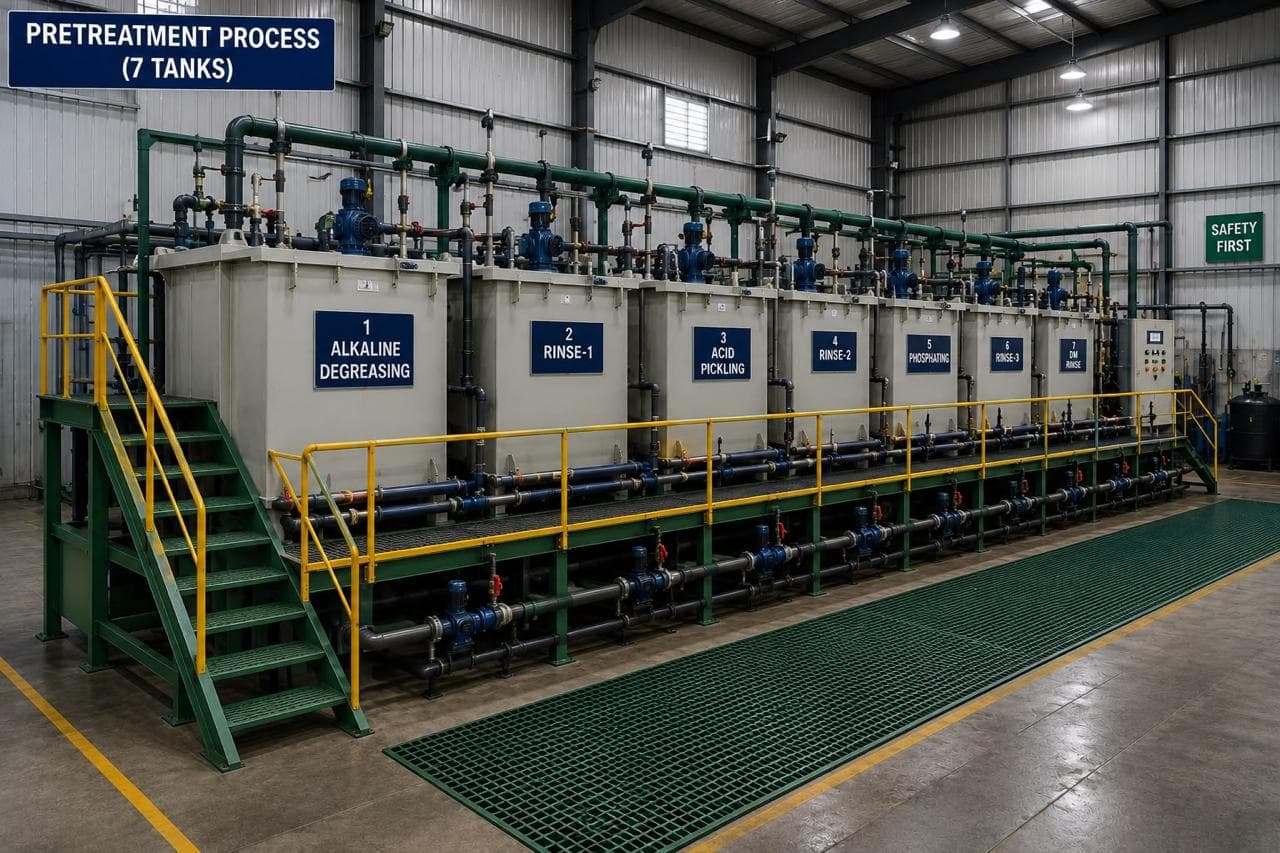
Parts are cut on a 12 kW fibre laser with a 40 ft × 16 ft bed or blanked on presses from 20 T to 300 T, formed on the 200 T 5-axis brake, welded on three CLOOS robotic cells and coated on the seven-tank line before packing. Packing and dispatch is its own station, with pallets checked, corner boards fitted and the label matched to the dispatch document before the stack leaves the bay.
The plants hold ISO 9001:2015 and ISO 14001:2015, and the environmental system pushes against over-packing for its own reason: every kilogram of film and board that leaves the gate becomes waste at the customer's site. Elevator frames for TKE and Eros, canopies for Mahindra Powerol and railway components for Indian Railways have all shipped from these units, and each has a pack sized to the part rather than to a template. The plant and quality hub covers the dispatch and handling records that sit behind the pack.
What to put in the pack specification
- Part number, revision and quantity per pack, with the pack count per pallet and the maximum stack height.
- Which faces are cosmetic, and therefore which faces need interleaving.
- Whether the part is bare, phosphated or powder coated, because that decides VCI and desiccant.
- Maximum storage time at the customer's end, which sizes the desiccant.
- Pallet size and entry, matched to the receiving forklift and the rack.
- Label content and position: part number, quantity, batch, date, and the barcode the store scans.
- Whether the pack is returnable, and who owns the return leg.
- Any test the customer requires, with the ISO 4180 schedule and the ISO 2233 conditioning stated.
The packing and dispatch route is quoted with the part, and the pack is part of the quote rather than an afterthought.
When a simpler pack is the better answer
A single-trip carton is the wrong pack for a part that travels 40 km to a line-side dock three times a week. Returnable steel racks, loaded at the press and unloaded at the customer's line, remove the packaging entirely and remove the unpacking labour with it.
Nor does every part need corrosion protection. A powder-coated assembly with a full film and masked threads will survive a monsoon week in a vented pack, and adding a sealed VCI wrap costs money and traps the moisture it was meant to exclude.
And where the part is large enough to need a crate, the crate is not the place to save. A 4,450 mm bent section that bows in transit is scrap, and the crate that holds it straight is the cheapest item on the order.
Size the pack to the stack, to the road and to the weather, and let the arithmetic decide where the material goes. Send the part, quantity and receiving method through the RFQ and the pack is quoted with the part.
Frequently asked questions
How much packaging should a sheet metal part have?
Enough to survive stacking, road vibration and a monsoon week, and no more. Packaging typically lands at 0.5–2% of part value. Above that, the cost is usually paying for handling damage that started inside the plant.
Should powder-coated parts be stretch wrapped?
Yes, but loosely and only after the film has cured and cooled. Film stretched over 20% pulls tight against edges, prints the powder and can trap condensation. Interleave with foam or paper first, then wrap.
When is desiccant needed in a pack?
Whenever the pack is sealed and the part is bare or phosphated steel. Two kilograms of silica gel absorbs roughly 200 g of water, which covers the ingress through a 2 m² film barrier over a three-month storage period.
Are wooden crates always better than cartons?
No. A crate adds mass, cost and unpacking time. It is justified where the stack load exceeds what a carton can carry, where the part is large or heavy, or where the customer's receiving area cannot handle a pallet of cartons.
How many parts can be stacked in one pack?
Set the limit by the load the bottom part can take without permanent set, not by how many fit. For 0.8 mm panels, four to six layers per pack with interleaving is typical; more than that needs a rack or a crate.
Sources and further reading
- ISO 4180 — Complete, filled transport packages: test schedules · reviewed 3 Nov 2026
- ISO 2233 — Conditioning of test specimens before packaging tests · reviewed 3 Nov 2026
- IS 2771 — Corrugated fibreboard boxes, specification (BIS) · reviewed 3 Nov 2026
Shipping assemblies to a line-side dock?
Send the drawing, the pack quantity and the receiving method. The quotation covers the pack specification, the pallet configuration and the label data your store needs.
Request a quote