Key takeaways
- IEC 60529 tests the assembled enclosure with its glands, filters and breathers fitted, so an IP65 quote for bare sheet metal is a claim without a test.
- A 20 mm gasket at 0.05 N/mm² applies about 1 N per mm of perimeter, which is 2.8 kN on a 600 x 800 mm door before anyone adds a latch.
- A sealed 0.5 m³ enclosure that warms by 25 K reaches roughly 8.2 kPa internal pressure, enough to push air past the gasket and pull water back in as it cools.
- A return flange on the door edge raises edge stiffness by more than 1,000 times against a flat 1.5 mm panel, which is cheaper than a thicker door.
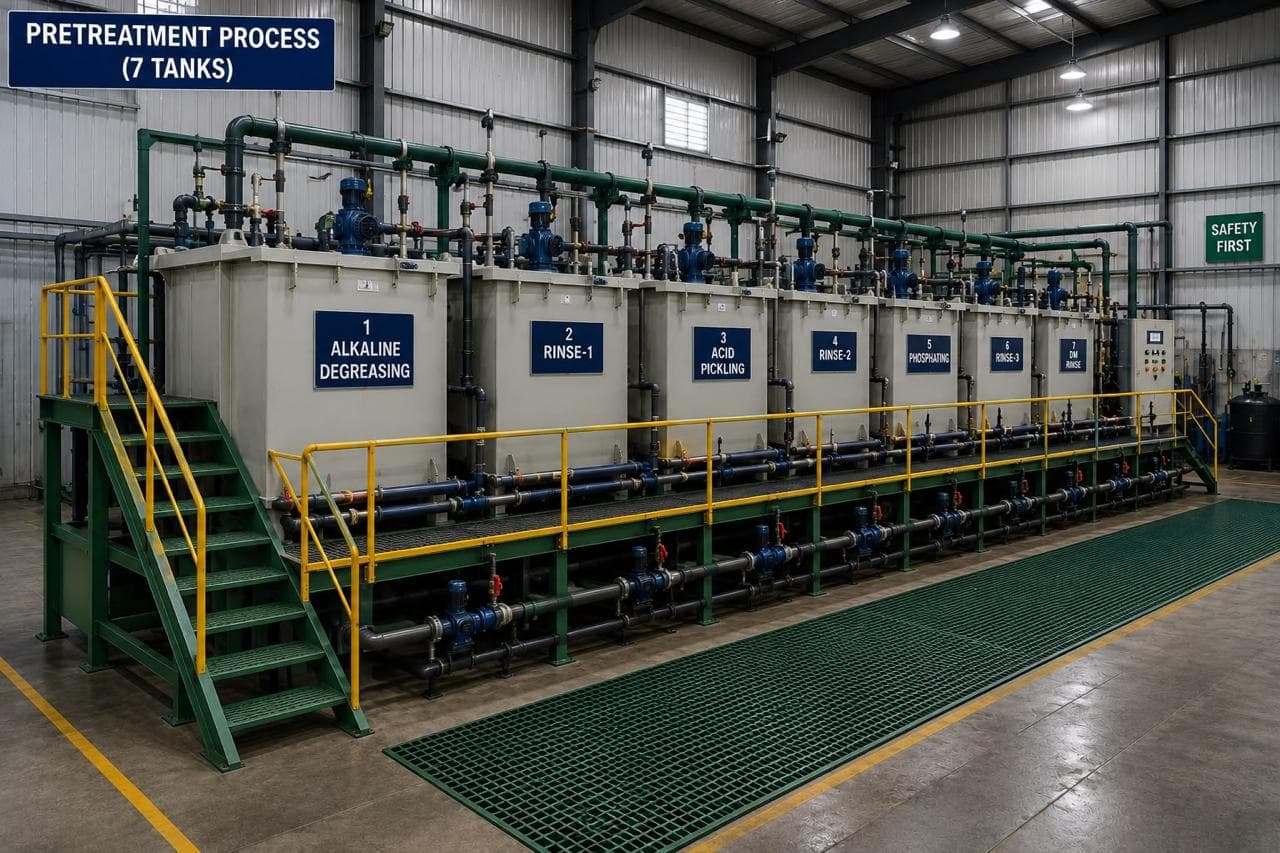
- Ganesh cuts and bends enclosure parts to 10 mm on a 4,450 mm bed, welds in three CLOOS cells and powders over seven-tank pretreatment, but does not issue the IP test certificate.
Two enclosures leave the same shop, from the same drawing, with the same powder finish. One passes IP65 on the first attempt and the other fills with water in a wet week. The difference is rarely the steel. It is the gasket land, the door stiffness, a weld that stops 20 mm short of a corner and a cable gland chosen by someone who was not told what the box has to survive.
An outdoor enclosure IP rating is a property of the assembled product, tested as installed. IEC 60529 defines the IP code and the test conditions: the first digit is protection against solid objects and dust, the second against water. The standard tests the enclosure with its entry devices fitted, because that is what the customer mounts on a wall. Any quotation that promises "IP65 sheet metal" is describing a material, not a product.
This article sets out what the test actually applies, where a fabricated enclosure leaks, the gasket and pressure arithmetic behind the seal, and the fields to put on the drawing. The enclosure family is indexed in the data centre racks and enclosures hub, and the coating failures that make an IP-rated box look wet inside are covered in why powder coating fails on outdoor enclosures.
What does an outdoor enclosure IP rating actually test?
The IP code is two numbers and sometimes a letter. The first digit runs from 0 to 6 for solids: 4 means protected against objects over 1 mm, 5 means dust-protected, 6 means dust-tight. The second runs from 0 to 8 for water: 3 is spraying, 4 is splashing, 5 is a 6.3 mm jet at 12.5 L/min, 6 is a 12.5 mm jet at 100 L/min, 7 is temporary immersion at 1 m for 30 minutes.
The dust test is a chamber test. For IP5X the enclosure sits in a talcum powder atmosphere for eight hours, and the pass criterion is that dust does not enter in a quantity that interferes with operation. For IP6X the same chamber is run with a vacuum applied inside the enclosure, and no dust may enter at all. That vacuum is the detail most fabricators miss: it turns every pinhole in a weld and every unfilled fastener hole into a leak path at a pressure difference the box never sees outdoors.
The water tests are directional and timed. Splash and jet tests run for minutes, not hours, and they are aimed at the surfaces the standard specifies, including the gasket line and the cable entries. A box that passes IPX5 can still fail in service if it is mounted with the door facing the weather and the drain pointing uphill.
Where does an IP65 enclosure actually leak?
There are six paths, and they fail in a predictable order.
The gasket land. A closed-cell gasket seals by compression, not by contact. If the land is not flat, the gasket touches at the high points and leaves a gap at the low ones. On a door welded from four bent sides, the corners are the high points because the bend radii overlap, and the mid-span is the low point because the panel bows. The seal opens at the corners first, which is why a leak usually appears as a damp patch at the bottom corner rather than across the door.
Door stiffness. A flat 1.5 mm door with no return flange is a plate held only at its edges. Under latch load it bows, and the bow is largest where the gasket needs the most pressure. A 20 mm return flange on the door edge changes the edge section from 0.28 mm⁴ per mm of width to more than 1,000 mm⁴, which removes the bow for the cost of one extra bend.
Weld continuity. A stitch-welded corner, or a weld that stops short of the end, leaves a gap that is invisible under powder. On an IP65 box every corner seam that crosses the gasket line should be continuous, or sealed with a flexible sealant that stays elastic at the service temperature.
Cable entry. A 22 mm gland hole is a larger opening than any gasket defect. Each gland, blind plug and conduit entry has to be rated at least to the enclosure IP, and the hole has to be deburred so the gland's own seal sits flat.
Pressure equalisation. A sealed box is a pressure vessel with a weak lid. Warming 0.5 m³ of air by 25 K raises internal pressure by roughly 8.2 kPa, which is 3.9 kN on a 600 x 800 mm door. That is more than the 2.8 kN the gasket is designed to carry, so air escapes past the seal and moist air is drawn back in as the box cools.
Condensation. Even a perfect seal traps the moisture that was inside when it was closed. A box closed at 30 °C and 80% RH holds air with a dew point near 26 °C, so any internal surface below that temperature collects water. A breather and a drain do more for a year of service than another 20 µm of powder.
Latch spacing follows from the gasket load, and it is the number most drawings leave out. A 20 mm closed-cell gasket compressed 30% develops about 0.05 N/mm², which is 1 N per millimetre of perimeter. A 600 x 800 mm door has 2,800 mm of perimeter, so the gasket pushes back with 2.8 kN before the door is even closed.
Two latches at mid-height share that load at 1.4 kN each, which is why a single central latch on a tall door bows the panel above and below it and opens the seal at the top corner. Three-point latching or a pair of hinges plus two latches distributes the compression and keeps the gasket inside its 0.9 mm working range. If the enclosure adds a filter fan, the fan gasket adds its own load and its own leak path, and the filter has to be rated for the same IP as the box.
IP ratings against the features that deliver them
The table links the code to the test and to the sheet-metal feature that decides whether the enclosure passes.
| IP code | Test condition | Typical outdoor use | Ganesh limit or note |
|---|---|---|---|
| IP54 | Dust-protected; splashing water, 10 L/min | Sheltered plant room, canopy underside | 1.5 mm door with return flange; gasket land within ±0.3 mm |
| IP55 | Dust-protected; 6.3 mm jet at 12.5 L/min | Washdown bay, genset canopy interior | Continuous corner welds on the gasket line; 60-90 µm powder DFT |
| IP65 | Dust-tight; 6.3 mm jet at 12.5 L/min | Outdoor wall mount, pole mount | 2.0 mm door or flanged 1.5 mm; breather rated to the same IP |
| IP66 | Dust-tight; 12.5 mm jet at 100 L/min | Coastal and monsoon exposed sites | Door stiffness and latch count set the result, not steel grade |
| IPX7 | Immersion at 1 m for 30 min | Buried or flood-prone pits | Outside a folded-sheet route; needs a sealed, tested design |
| Gasket compression | 3 mm closed-cell, 30% compression | All of the above | 0.9 mm usable compression; land flatness is the controlling feature |
| Door size | 600 x 800 mm typical | Wall and floor cabinets | Bending to 10 mm on a 4,450 mm bed; 18 ft x 14 ft powder booth |
What sheet-metal features decide the result?
Flatness at the gasket land is the first. It is set by the blank, the bend and the weld, in that order. A laser-cut blank has a clean edge and consistent dimensions; a punched blank is faster at volume but the burr side must face away from the gasket. The bend line has to be parallel to the land within 0.3 mm over the door height, or the gasket compresses unevenly even when the door is flat.
The second is the door construction. A single-skin door is adequate up to about 600 mm wide if it has a return flange on all four sides. Beyond that, a double-skin door or a stiffener across the middle is cheaper than going from 1.5 mm to 2.5 mm steel, because stiffness rises with the cube of the section depth and only linearly with thickness. A 20 mm return is worth more than 1 mm of extra sheet.
The third is hole and fastener practice. Every fastener that passes through the enclosure wall is a potential leak. Studs welded to the inside, or blind threaded inserts, keep the wall closed. Where a through-bolt is unavoidable, specify a sealing washer and a clearance hole that the washer covers fully, not a slotted hole.
The fourth is coating. Powder on the gasket land is a liability: it builds 60-90 µm, it is compressible, and it varies around the perimeter. Mask the land, or design the gasket to sit on bare pretreated steel. The same masking logic applies to earth points and to any surface that carries a conductive bond. Welded sheet metal enclosures sets out the joint details that keep a seam closed.
How do you specify IP on the drawing?
Put the code, the mounting orientation and the entry schedule in the title block area, not in a general note. The enclosure only earns its rating in the orientation it was tested in, and a box designed for a vertical door will leak if the site mounts it face-up.
- IP code for the assembled enclosure, with the test standard, for example IP65 to IEC 60529.
- Mounting orientation and the faces exposed to weather.
- Gasket type, groove or land width, and compression allowance.
- Door thickness, return flange size and latch positions.
- Cable entry schedule: gland sizes, positions, and the IP rating of each device.
- Breather or drain location, with the IP rating of the device.
- Weld finish on the gasket line: continuous, sealed or ground flush.
- Coating system, DFT and the masking drawing for gasket land, earth points and threads.
- Test requirement: who tests the assembled enclosure, at what orientation, and what record is supplied.
A drawing with these nine fields can be built and tested without a discussion about what "weatherproof" means. The box bending for electrical enclosures article covers the bend reliefs that stop a corner cracking before the gasket ever sees water.
What Ganesh runs for outdoor and data centre enclosures?
Ganesh fabricates enclosures for data centre, genset, elevator and industrial customers from laser-cut blanks on the 12 kW fibre laser with its 40 ft x 16 ft bed, or from 250 T punched blanks at volume. Doors and bodies are bent on the 200 T, 5-axis brake with a 4,450 mm bed, which takes a full-height door in one handling and keeps the bend line square to the edge.
Frames and door stiffeners are welded in three CLOOS robotic MIG cells or at 30+ manual MIG/MAG and spot stations, with fixtures built in the in-house tool room so the gasket land repeats from part to part. Coating is seven-tank pretreatment, a 16 ft x 16 ft shot blast chamber where the surface needs it, and powder in an 18 ft x 14 ft booth, with DFT and cross-hatch adhesion records per batch. The five units across Mumbai (Vasai) and Nagpur hold ISO 9001:2015 and ISO 14001:2015.
The data centre racks product page lists the enclosure families, and the finished coated assemblies capability explains how masking, coating and hardware are planned as one release. What we do not do is issue the IP certificate: the test belongs to a test house, on the assembled product, in the orientation the site will use.
When is a fabricated enclosure the wrong route?
IPX7 and IPX8 immersion duty, IP69K high-pressure washdown and any enclosure that must hold pressure are outside a folded and welded sheet route unless the design has been tested as a sealed pressure vessel. Cast aluminium and moulded enclosures solve those cases with a single sealing face and no weld.
Hazardous-area certification, EMC shielding above about 40 dB and fire-rated enclosures also need a certified design and a test regime that a sheet-metal fabricator does not own. Ganesh will build the mechanical parts to the drawing, but the declaration belongs to the product owner.
If the requirement is a standard outdoor cabinet in a monsoon climate, with a door that opens for service and a cable entry at the bottom, the fabricated route is the right one, and the seal is decided by three numbers: land flatness, door stiffness and the pressure the box has to breathe through. Send the enclosure drawing with the IP code and entry schedule through the quotation route, and the review starts at the gasket line rather than at the powder colour.
Frequently asked questions
Does IP65 sheet metal exist on its own?
No. IEC 60529 tests a complete enclosure with its doors, gaskets, glands, filters and breathers in place. The sheet metal contributes flatness, stiffness and weld continuity, but the rating is issued against the assembled product and the way it is installed.
What is the difference between IP54 and IP65?
IP54 is protected against dust in limited quantity and against splashing water from any direction. IP65 is dust-tight and protected against water jets from a 6.3 mm nozzle at 12.5 L/min. The jump from splash to jet is what usually forces a gasket change, not a steel change.
Why does my IP66 enclosure have water inside after a year?
Usually condensation, not ingress. A sealed box that heats and cools pulls moist air through the gasket and glands and condenses it on cold surfaces. A pressure-equalisation breather rated to the same IP, plus a drain at the low point, removes the cycle.
How flat does the gasket land need to be?
Within about ±0.3 mm around the perimeter for a 3 mm closed-cell gasket compressed 30%, which gives 0.9 mm of usable compression. A door that bows 2 mm at mid-span uses that allowance up and the seal opens at the corners first.
Can Ganesh certify an enclosure to IP65?
Ganesh builds and inspects the enclosure to the drawing and supplies dimensional, weld and coating records. The IP test is carried out by a test house on the assembled product, and the certificate is issued against that test.
Sources and further reading
- IEC 60529 - Degrees of protection provided by enclosures (IP code), including dust and water jet test conditions · reviewed 3 Nov 2026
- ISO 12944-2:2017 - Corrosivity categories for steel structures, used to select the coating for outdoor duty · reviewed 3 Nov 2026
- BIS - IS 513 cold reduced steel sheet and IS 2062 structural steel grades · reviewed 3 Nov 2026
Send an enclosure drawing with its IP target
Include the IP code, mounting orientation, cable entry schedule and coating category. We review gasket land, door stiffness and weld route before quoting.
Request a quote