Key takeaways
- The IPX5 jet is a 6.3 mm nozzle at 12.5 L/min and IPX6 is a 12.5 mm nozzle at 100 L/min, both held 2.5–3 m away for at least 3 minutes, so IP66 is an eight-fold increase in water flow.
- A 3 m door perimeter with a hollow gasket at 10 N per 100 mm needs about 300 N of latch load, and the door frame has to hold 0.3 mm of bow or the seal unloads at mid-span.
- A 50 x 30 x 1.5 mm door stile bows 0.41 mm under that gasket load over 1,500 mm, which is 14% of a 3 mm compression; a 40 mm stile loses 23% and leaks at the latch side.
- IEC 60529 does not cover condensation, and a 1 m³ enclosure cycling 10 K moves 33 L of air through its seals, so a sealed box still needs a breather or a drain.
An IP rating is a test result on an assembled enclosure, not a property of a folded box. IEC 60529 defines the code and the tests, and the tests are run on a complete unit with its door, gasket, hinges, latches and cable entries in place. A fabricator who quotes "IP66" against a sheet metal drawing has quoted a result they do not control, because the sealing is decided by the gasket land, the latch spacing, the gland plate and the finish, and only some of those are on the drawing.
The numbers are worth knowing before the enquiry goes out. The IPX5 jet is a 6.3 mm nozzle at 12.5 L/min; the IPX6 jet is a 12.5 mm nozzle at 100 L/min. Both are held 2.5–3 m from the enclosure for at least 3 minutes. The second test carries eight times the water of the first, and a door that passes one can fail the other at the same corner.
What follows covers the two digits and what each test actually does, the gasket load and door stiffness that decide whether a seal holds, and the points where the standard stops and another document has to take over.
What an IP rating covers, and what it does not
IEC 60529 applies to enclosures for electrical equipment rated at up to 72.5 kV. It defines the IP code, the degrees of protection for access to hazardous parts, for ingress of solid foreign objects and for ingress of water, and it sets the test methods and the acceptance conditions for each degree. The first digit runs from 0 to 6 and covers solids and access; the second runs from 0 to 8 and covers water. Optional letters can follow, for access to hazardous parts or for high-voltage equipment.
The scope is narrower than the marketing around it. The standard does not cover protection against mechanical damage, explosive atmospheres, corrosive vapours, condensation, or the performance of the equipment inside. It does not cover the installation either: a gland that is not tightened, a conduit that fills with water, or a door that was left unlatched are outside the test. And it does not grade a component. There is no such thing as an IP-rated sheet, hinge or weld; the rating belongs to the assembled unit in the configuration that was tested.
The code is also not a ladder. The first digit is cumulative in the sense that 6 implies 5, but the water digits are not: IPX6 does not imply IPX7, because a jet and an immersion load the seals in different ways, and IPX7 and IPX8 are not comparable with each other because IPX8 is set by agreement between the buyer and the test house. A 2013 amendment added IPX9 for high-pressure, high-temperature jets; the "K" variants that appear on vehicle components belong to ISO 20653, not to IEC 60529.
What the tests actually do
The dust test for the first digit 5 and 6 runs for 8 hours in a talcum atmosphere, with the enclosure under a partial vacuum of about 2 kPa where the design allows air to be drawn through. For 6, no dust may enter. For 5, a small amount is allowed provided it does not interfere with operation or settle in a position that causes failure. That difference is what separates "dust protected" from "dust-tight", and it is the difference between an unsealed louvre and a welded box.
The water tests are more varied, and each one loads a different part of the enclosure:
- IPX4 is splashing water from an oscillating tube or a spray head for 5 minutes. It finds gasket lands that are not flat and door tops that pond water.
- IPX5 is the 6.3 mm jet at 12.5 L/min from 2.5–3 m for at least 1 minute per square metre and never less than 3 minutes. It finds gaps at glands and at the corners where a gasket is compressed least.
- IPX6 is the 12.5 mm jet at 100 L/min and about 100 kPa, same distance and duration. It finds a door that bows under the jet and unloads its seal at mid-span.
- IPX7 is immersion at 1 m for 30 minutes, measured to the lowest point of the enclosure. It finds rivets, seamed joints and unwelded hems.
A test house aims the jet at the worst places, not the middle of a panel: the door edge, the gland plate, the latch, the weld at a corner. That is why a sample that looks well finished can fail while a plainer one passes. The test is about the joints, and the joints are where the design is either thought through or not.
Gasket load is what sizes the door
A door seal works by compression. A hollow EPDM bulb gasket needs 25–30% of its section compressed to seal, and the force to do that is roughly 10 N per 100 mm of length for a 12 mm bulb. On a 1,000 mm × 1,500 mm door the gasket runs about 5 m around the perimeter, so the latch has to pull the door in against roughly 500 N. Take a 3 m perimeter, which is a 1,000 mm × 500 mm door, and the load is about 300 N.
That load is not the problem; distributing it is. The latches pull at two or three points, and between them the door frame has to stay straight enough to keep the compression. If the frame bows 0.3 mm between latches, the gasket loses 10% of its 3 mm compression at that point and the seal becomes marginal. The stiffness needed follows from a beam check. Treat the stile as a simply supported beam over the 1,500 mm between latch and hinge, carrying the gasket load as a uniformly distributed load of 0.1 N/mm on each stile:
I = 5 w L⁴ / (384 E δ) = 5 × 0.1 × 1,500⁴ / (384 × 206,000 × 0.3) = 106,700 mm⁴
A 50 × 30 × 1.5 mm closed section has I = 78,900 mm⁴, so it bows:
δ = 5 × 0.1 × 1,500⁴ / (384 × 206,000 × 78,900) = 0.41 mm
That is 14% of the compression, which is tolerable on a dry indoor panel and marginal on an outdoor one. A 40 × 30 × 1.5 mm stile at I = 46,000 mm⁴ bows 0.70 mm, loses 23% of the compression and leaks at the middle of the latch side. A 60 × 30 × 1.5 mm stile at 123,000 mm⁴ bows 0.26 mm and holds. The gasket is not the variable here; the stile is.
This is also why adding a thicker gasket makes an IP problem worse. A thicker bulb needs more compression force, which needs more latch load, which bows the door further. The fix is a stiffer door and a gasket with a lower closure force, not a bigger gasket.
The numbers behind an IP claim
| Parameter | What IEC 60529 sets | Ganesh limit or note | Consequence if missed |
|---|---|---|---|
| IP6X dust | 8 hours in talc, no dust ingress for 6 | Fully welded seams, no open hems, gasket at 30% compression | Dust tracks through a hem into the panel |
| IPX4 splash | Oscillating tube or spray head, 5 minutes | Gasket land flat to 0.5 mm over its length | Water reaches the door edge and the latch |
| IPX5 jet | 6.3 mm nozzle, 12.5 L/min, 2.5–3 m, 3 minutes | Hollow bulb gasket, about 300 N of latch load on a 3 m door | Jet enters at a gland or a corner |
| IPX6 jet | 12.5 mm nozzle, 100 L/min, about 100 kPa | Door stile 60 × 30 × 1.5 mm minimum above 1,200 mm | Seal unloads at mid-span and weeps |
| IPX7 immersion | 1 m for 30 minutes | Welded box, no rivets or unwelded hems below the line | Weep at a rivet or a seam |
| Assembly condition | Tested as installed | Test with glands, hinges, labels and latches fitted | Certificate covers a different build |
| Condensation | Not covered | Breather membrane or drain plug; 33 L per 10 K per m³ | Internal corrosion and water on the floor |
| Cable entry | Not covered | Gland plate 3 mm, holes laser-cut to ±0.3 mm | Gland seal distorts and leaks |
| Gasket material | Not covered | EPDM closed cell, 25–30% compression, 70 °C rated | Compression set and a permanent leak |
| Finish | Not covered | Seven-tank pretreatment, powder at 80–100 µm | Blisters and rust after the test |
| Evidence | Report covers one tested configuration | First article dimensions and a build record | A certificate that cannot be matched to the unit |
Two rows in that table are the ones most often argued. The assembly condition is the first: a buyer will send a certificate with the enclosure and a fabricator will build a variant with a taller door and an extra gland, and the certificate is then worthless. The condensation row is the second, because no IP test detects it and no IP code promises against it.
Condensation: the failure the rating does not cover
A sealed enclosure is not a dry enclosure. Air inside it expands and contracts with the duty cycle of the equipment, and every expansion pushes air out through the seal, every contraction draws it back in with moisture. For 1 m³ of air at 300 K, a 10 K rise changes the volume by:
ΔV = V × ΔT / T = 1 × 10 / 300 = 0.033 m³ = 33 L
Thirty-three litres per cycle is a lot of breathing for a gasket that was chosen to keep out a jet. The water arrives as vapour, condenses on the cold steel in the early morning, and sits at the bottom of the enclosure because there is nowhere for it to go. A breather membrane equalises the pressure without passing liquid water, and a drain plug at the lowest point lets out what does condense. Both are cheap at the design stage and awkward after the enclosure is installed on a plinth.
The same arithmetic explains why an IP66 enclosure in a coastal plant can rust from the inside while a louvred IP54 one does not. The louvred box breathes freely and drains; the sealed box breathes through its gasket and keeps the water.
Where the standard stops
IEC 60529 stops at ingress. It does not cover corrosion, and a coastal installation usually needs a salt-spray test to ISO 9227 as well. It does not cover ultraviolet ageing, which is ISO 4892-3 for laboratory exposure. It does not cover impact, which is IEC 62262 and the IK code, and an enclosure that passes IP66 can still be dented by a pallet truck and lose its seal. It does not cover EMC, fire performance or the thermal rating of the equipment inside.
It also does not define a leak rate. The test is pass or fail on harmful ingress, judged after the exposure, so two enclosures can both pass IP66 with very different amounts of water inside. If the equipment is sensitive, the specification has to add a leak test or a humidity test on top of the rating.
The last limit is the certificate. A test report covers the sample as built: the door size, the gasket section, the latch count, the gland plate and the finish. Change any of those and the report no longer describes the product. A supplier who offers "IP66" as a catalogue property across a range of sizes is offering an assessment, not a test result, and the buyer should ask which size was tested.
What Ganesh builds for a sealed enclosure
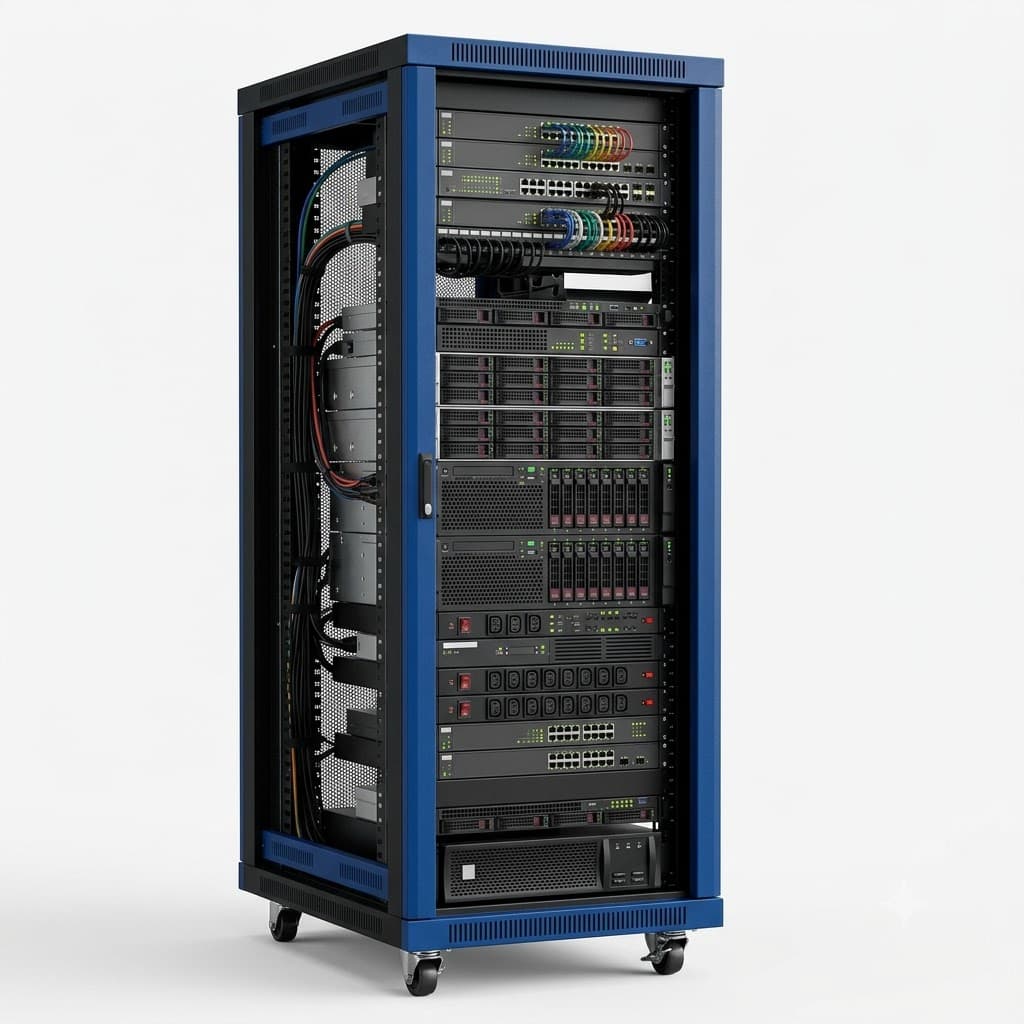
Enclosures for data centre, genset and industrial use are cut on the 12 kW fibre laser with its 40 ft × 16 ft bed, which gives a square edge on the door and the gland plate, and formed on the 200 T, 5-axis brake with the 4,450 mm bed, which folds a 60 mm return on a 2,000 mm door in one pass. The box is welded on three CLOOS robotic MIG cells or at the manual stations, blasted in the 16 ft × 16 ft chamber, and coated after the seven-tank pretreatment line in the 18 ft × 14 ft powder booth at 80–100 µm.
Three details decide whether the coating helps or hurts the seal. The gasket land is masked, because powder on the land changes the compression by the film thickness. The gland plate is cut and formed to sit flat, because a plate that rocks opens the gland thread. And the door is checked for bow across the latch span before the gasket goes on, because a door that is already 0.4 mm out has used up the compression allowance.
Sealed enclosures and racks ship through data centre racks and custom parts, and the finished coated assemblies capability covers the route from weld to packed unit. The welded enclosure guide covers the joint details that make a seam dust-tight, the equipment enclosure route covers the frame and door sequence, and the other enclosure standards sit in the standards and compliance hub.
What to put on the drawing
- The IP code, both digits, and the standard edition it is assessed against.
- The mounting position and the worst-case exposure: outdoor, washdown, coastal or indoor.
- The gasket: section, material, compression and the land flatness it needs.
- The latch count and position, and the door bow limit between latches.
- The gland plate: thickness, hole sizes, and whether the glands are supplied or site-fitted.
- The breather or drain position, if the enclosure is sealed.
- The finish, including masked areas at the gasket land and the earth pad.
- The evidence: which size was tested, what was fitted during the test, and the report reference.
When an IP rating is the wrong specification
An IP rating is the wrong specification for a washdown area in a food or pharmaceutical plant. Those need IPX9 plus a hygienic design: sloped surfaces, no horizontal ledges, no exposed threads and a drainable bottom. IP66 does not survive an 80 °C caustic wash, and the gasket that passes the jet test may not be chemically compatible with the cleaner.
It is also the wrong specification where the threat is corrosion rather than water. A coastal site needs a salt-spray rating and a coating system, and the IP code says nothing about either. Where the threat is impact, the IK code is the relevant one. And where the enclosure is indoors in a clean room, IP54 is enough, and paying for IP66 buys a heavier door, a bigger latch and a breather that nobody maintains.
The honest position is that IP is one property among several, tested on one sample in one configuration. Send the enclosure drawing with the IP code, the mounting position and the cable entries, and the engineering team will confirm the gasket land, the latch spacing and the finish before the price is fixed. Request a quote.
Frequently asked questions
Does an IP rating apply to a sheet metal enclosure on its own?
No. IEC 60529 tests the enclosure as an assembly, including the door seal, the hinges, the latches and the cable entries. A bare folded box has no rating; the rating belongs to the completed unit in the configuration that was tested.
What is the difference between IPX5 and IPX6?
IPX5 uses a 6.3 mm nozzle at 12.5 L/min and IPX6 a 12.5 mm nozzle at 100 L/min, both at 2.5–3 m and for at least 3 minutes. The flow is eight times higher at IPX6, which is why a gasket that passes IPX5 can still fail IPX6 at the latch side.
Does IP66 mean the enclosure is waterproof?
It means dust-tight and protected against powerful water jets in the test configuration. It says nothing about immersion, condensation, corrosion or chemical washdown. IPX7 or IPX8 covers immersion, and each is a separate test on a separate sample.
Why does a sealed enclosure still fill with water?
Condensation. A 1 m³ enclosure cycling 10 K moves about 33 L of air through its seals and glands, and moisture enters with it. A breather membrane, a drain plug at the low point or a desiccant is the fix, and none of them is part of the IP test.
Can a certificate be reused for a modified enclosure?
Only if the modification is outside the tested configuration. A different gland plate, a longer door, a different gasket or a change in latch count all change the sealing behaviour, so the test has to be repeated or the change assessed by the test house.
Sources and further reading
- IEC 60529:1989+AMD1:1999+AMD2:2013 — Degrees of protection provided by enclosures · reviewed 3 Nov 2026
- IEC — Ingress protection (IP) ratings explained · reviewed 3 Nov 2026
- ISO 20653:2023 — Degrees of protection (IP code) for road vehicles · reviewed 3 Nov 2026
Send the enclosure and the sealing detail
State the IP code, the mounting position and the cable entries. The engineering team checks the gasket land, the latch spacing and the finish before quotation.
Request a quote