
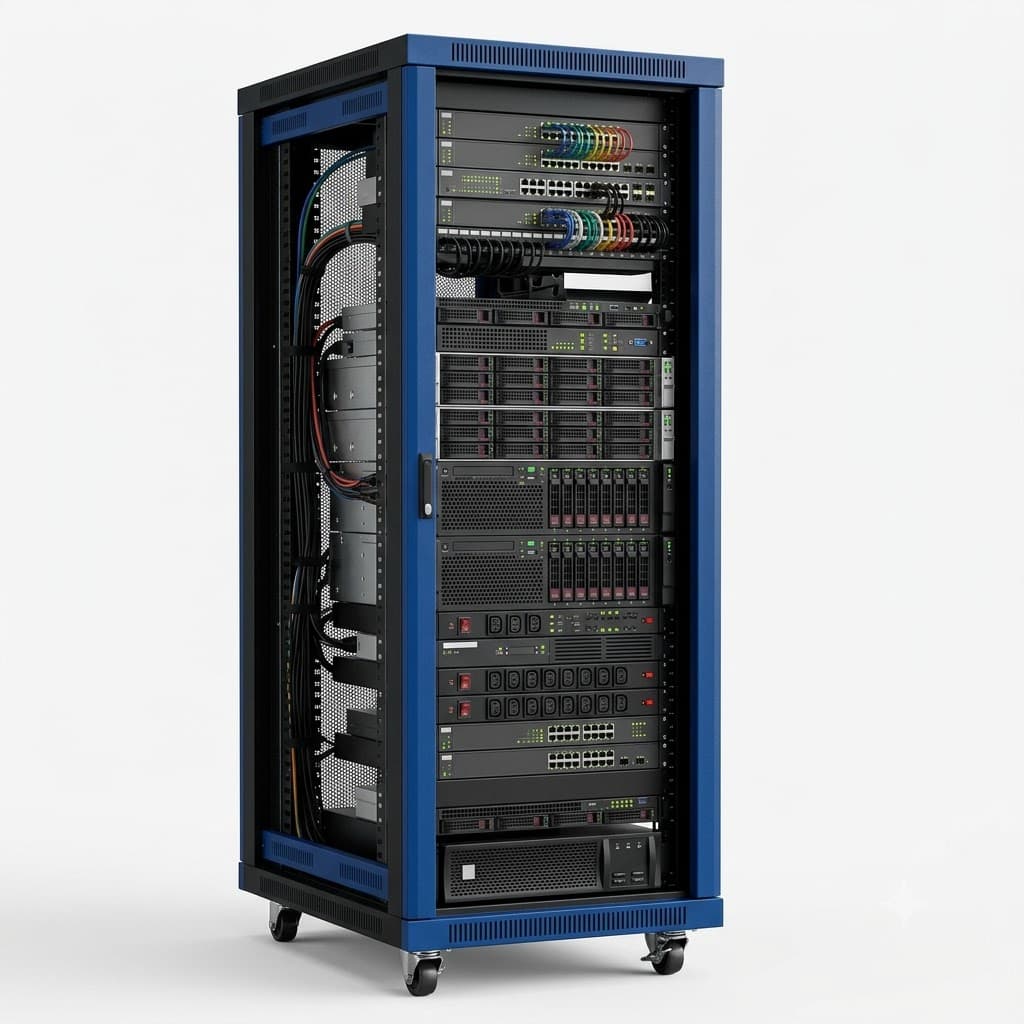
Key takeaways
- 482.6 mm panel width, 465.1 mm mounting-hole centres and 44.45 mm per rack unit are fixed by the standard; a 42U internal height is 1,867 mm.
- A 42U frame in 1.6 mm CRCA uses about 6.8 m² of steel, which weighs 85 kg at 7.85 kg/m² per millimetre of thickness.
- A 250 kg load on a single 750 mm rail pair deflects about 5.7 mm at mid-span with I = 18,000 mm⁴, which is why the corner posts carry the rack.
- Mask earth studs and cage-nut squares before pretreatment; powder in an earth point fails continuity at the customer's rack, not at ours.
A rack is a tolerance stack, not a box
Laser cut and bent enclosures are judged at the door gap and the rail pitch, long before anyone measures the weld. A 42U frame that is 1.5 mm out of square across a 2,000 mm post will not close its front door, and the same frame will still hold its mounting holes to the standard — which is why the two failures are found by different people at different times and only one of them gets blamed on the supplier.
The frame is a stack of decisions: how the post is folded, where the flat pattern puts each bend, how the frame is restrained while it is welded, how the rails are positioned relative to the front face, and how much powder goes on after all of that. Each step is a few tenths of a millimetre. Together they decide whether a 42U rack with a 1,000 kg payload looks like a precision product or a cabinet that needs a shim under one corner.
The numbers below are the ones we check before a rack drawing is quoted, and the ones to put on the drawing so they are checked at the other end as well.
The dimensions that are not yours to choose
Three dimensions come from the standard rather than the design. The panel width is 482.6 mm, the mounting-hole centres are 465.1 mm apart, and one rack unit is 44.45 mm of height. Change any of them and the rack stops accepting standard equipment, however good the fabrication is.
Everything else is a design choice: external width 600 mm or 800 mm, depth 800 mm to 1,200 mm, post section, rail profile, door type, cable entry and finish. Those choices decide the stiffness, the weight and the price, and they are where a buyer gets value rather than compliance.
One practical note on mounting holes. Square 9.5 mm holes for cage nuts and threaded inserts both work, but they need different clearances behind the rail and different masking if the frame is coated after assembly. Decide which the project uses before the rail drawing is released, because the hole pattern and the mask both follow from it.
Rack dimensions, deflection and coating at a glance
| Parameter | Standard or typical value | Ganesh limit or note |
|---|---|---|
| Panel width | 482.6 mm (19 in) | Cut on the 12 kW laser, 40 ft × 16 ft bed |
| Mounting-hole centres | 465.1 mm | Checked on first article, pin gauge on rails |
| Rack unit height | 44.45 mm per U | 42U = 1,867 mm internal |
| Frame steel | 1.5–2.0 mm CRCA | Bending to 10 mm on the 200 T brake |
| Post length | 1,800–2,200 mm typical | Formed in one pass on the 4,450 mm bed |
| Frame squareness | ±1.5 mm diagonal over 2,000 mm | Measured before coating, recorded on FAI |
| Rail deflection | Design-dependent | Declared with the design, not assumed |
| Coating film | 60–90 µm | DFT gauge and cross-hatch on first article |
| General tolerance | ISO 2768-1 class m | ±0.5 mm typical, tighter by agreement |
| Static load rating | Project-specific | No certified seismic rating is claimed |
Where a 42U frame gets its stiffness
Stiffness in a rack comes from the corner sections, not from the panel thickness. A post folded into a C or hat section with two 20 mm returns is several times stiffer than a flat strip of the same gauge, and it is the returns that resist the parallelogram movement which closes a door gap. Panels add very little.
Weight follows the same logic. A 42U frame in 1.6 mm CRCA uses roughly 6.8 m² of cut steel across posts, rails, top and base plates. At 7.85 kg/m² per millimetre of thickness, that is about 85 kg of steel before hardware, coating and packaging — the figure that decides whether the frame ships assembled on a pallet or flat-packed.
Bending sets the flat pattern. Take a 600 mm post with 80 mm flanges at each end, 1.6 mm CRCA, inside radius 1.6 mm. Bend allowance per 90° bend is 1.5708 × (1.6 + 0.44 × 1.6) = 3.62 mm, and the outside setback is radius plus thickness, 3.2 mm, so the bend deduction is 6.4 − 3.62 = 2.78 mm. The flat blank is 80 + 600 + 80 − 2 × 2.78 = 754.4 mm. Get that sum wrong by 1 mm and every post in the batch is 1 mm short, which shows up as a door that will not align.
Loads and rails: what the numbers say
A rack frame carries load in two ways. The corner posts take the vertical load down to the base, and the rails take the equipment load across the span between the front and rear posts. The posts are usually not the weak point; the rails are.
Take a single rail pair spanning 750 mm between posts, carrying 250 kg — 2,452 N — at mid-span. With a second moment of area of 18,000 mm⁴ per pair and steel at 210,000 N/mm², the mid-span deflection is δ = F L³ / (48 E I) = 2,452 × 750³ / (48 × 210,000 × 18,000), which is 5.7 mm. That is enough to make a 4U server sag visibly, and it is why a real rack uses two rail sets, a deeper rail section or a shelf that shares the load with the posts.
Run the same arithmetic for your own rail section in the rack load calculator before the drawing is fixed. A rail chosen for its appearance rather than its section modulus is the most common stiffness mistake in a fabricated rack.
Coating and earthing on a rack assembly
Rack frames go through the seven-tank pretreatment line, then the 18 ft × 14 ft powder booth and the curing oven. Film thickness is checked with a DFT gauge and adhesion by cross-hatch, and the colour is checked against the approved sample rather than the RAL chip, because two booths running the same RAL number produce visibly different results at 60 µm and 90 µm.
Earthing is the part of the finish that fails quietly. Earth studs, bonding points, cage-nut squares and any mating surface for a bonding strap have to be masked before pretreatment. A stud with powder on it passes visual inspection and fails a continuity test, and the fix at the customer's site is a tap and a touch-up that no longer matches.
Colour consistency across a shipped rack matters as much as film thickness when doors and side panels are coated separately and paired later. Coat a door set as one batch, keep the batch number on the packing list, and the second container matches the first.
Inspection plan for a rack frame
Measure in this order: frame squareness by diagonal, post-to-post distance, rail pitch and rail height from the base datum, door gap on all four sides, and the position of the mounting-hole pattern from the front face. Then check flatness on the base plate and the plinth, because a rack that rocks on a level floor has a base problem rather than a post problem.
After coating, re-check the door gap, the earth points and the film thickness, and record the rail face height because that is the dimension the equipment actually sees. Add a load check where the project specifies one, using the customer's method and recording the load, the point of application and the deflection measured.
First article inspection and PPAP documentation are available for rack programmes, and material traceability runs to mill certificates where the project requires it. The record that matters at the end is the one attached to the revision that was built, not the one filed with the original quotation.
What we run on rack and enclosure work
Frames run on the 12 kW fibre laser, a 40 ft × 16 ft bed machine that takes a 2,400 mm side panel in one pass instead of a splice. Forming is on the 5-axis brake, rated 200 T with a 4,450 mm bed and Delem control, to 10 mm, and the long bed is the reason a full-height post is bent in one operation. Welding uses three CLOOS robotic MIG cells and more than 30 manual stations for MIG/MAG, spot and SPM work, with fixtures built in-house.
Finishing runs through a 16 ft × 16 ft shot blast chamber, the seven-tank line, an 18 ft × 14 ft powder booth, a wet paint line and a curing oven, with effluent treatment on site. The data centre rack route covers 19-inch frames, server enclosures, cable management parts, blanking panels and battery cabinet bodies in CRCA, mild steel and aluminium.
Programmes run under ISO 9001:2015 and ISO 14001:2015. Published customer programmes include Godrej & Boyce, Minda and Gunnebo, and they follow the same drawing review, fixture, first article and release sequence as the rest of the plant.
What to put on the rack drawing
- The U height and the rail positions as dimensions from the base datum, not as notes.
- The mounting-hole pattern with the standard named, and whether cage nuts or threaded inserts are used.
- Post section and thickness, plus the inside bend radius, so the flat pattern is developed once and used on every release.
- Squareness and diagonal tolerance, and whether it is measured before or after coating.
- The load requirement with its test method and the point of application.
- Finish: process, colour reference, film thickness, masked points, and the earthing studs that must stay bare.
- Packaging: assembled on a pallet or flat-packed, with the door set paired and the batch number on the label.
Two related pieces cover the parts either side of this one: bending for rack frames and cabinets is where the rail and post geometry is decided, and welded sheet metal enclosures covers the assembly tolerance question. The data centre racks and enclosures hub collects the rest of the family, including laser cutting for electrical enclosure panels for the panel-level cut file rules.
When this route is wrong
A fabricated frame is not a certified structure. If the project needs a seismic qualification, a dynamic load rating or a third-party tested static load, the frame has to be tested to that method after it is built, and the certificate belongs to the tested configuration rather than to the drawing. We do not publish a certified seismic rating, and a project that needs one should plan the test into the programme.
Very light gauges are the second limit. Below about 1.0 mm, a 42U frame loses the stiffness that keeps a door aligned after transport, and the money saved on steel is spent on straightening and on doors that need adjustment at site. Thicker posts and a deeper section cost less than a rejected delivery.
The third case is stainless. A washdown or food-grade enclosure in 304 or 316 is a different draw and a different finish route, and the masking, passivation and weld dressing all change. It can be cut and formed on the same lines, but it should be quoted as a stainless assembly rather than as a painted one, because the finishing time is not comparable.
The fourth case is flat-pack. A rack designed to ship flat and be assembled on site needs locating features, fasteners and an assembly instruction that a fabricated welded frame does not. Deciding this after the drawing is released changes the design more than it changes the process.
Frequently asked questions
What is the difference between a 42U and a 47U rack frame?
The internal height. One rack unit is 44.45 mm, so 42U is 1,867 mm of usable internal height and 47U is 2,089 mm. The 482.6 mm width and 465.1 mm hole centres do not change, which is why the same rail profile runs across both heights.
How much load can a fabricated rack frame carry?
The frame carries what the design and the test method prove, not what the material implies. Ask for a declared static load with the test method and the point of application. We do not publish a certified seismic or dynamic load rating; where the project needs one, the frame has to be tested to the project's method.
Should rack frames be welded or bolted?
Welded frames hold squareness better through handling and transport, and give a stiffer corner. Bolted frames ship flat and can be assembled on site. For a 42U frame that leaves the factory assembled, welding plus a checked diagonal is the usual route.
What powder coating thickness is specified on rack panels?
60–90 µm is the common range for interior powder finishes, measured on a DFT gauge and checked for adhesion by cross-hatch. Above about 120 µm the film becomes brittle at the bend and at fixing points; below 50 µm the coverage on an edge is unreliable.
Can the rack frame be supplied with the mounting rails and hardware fitted?
Yes. Rails, blanking panels, cable management and earth studs can be supplied as one coated assembly, with the masked points protected through pretreatment and cure.
Sources
Send the rack drawing with the rail pitch marked
Include the U height, rail positions, load requirement and finish. The engineering team checks the bend sequence and the coating plan before quotation, so the door gap and the rail pitch are held on the first frame.
Request a quote